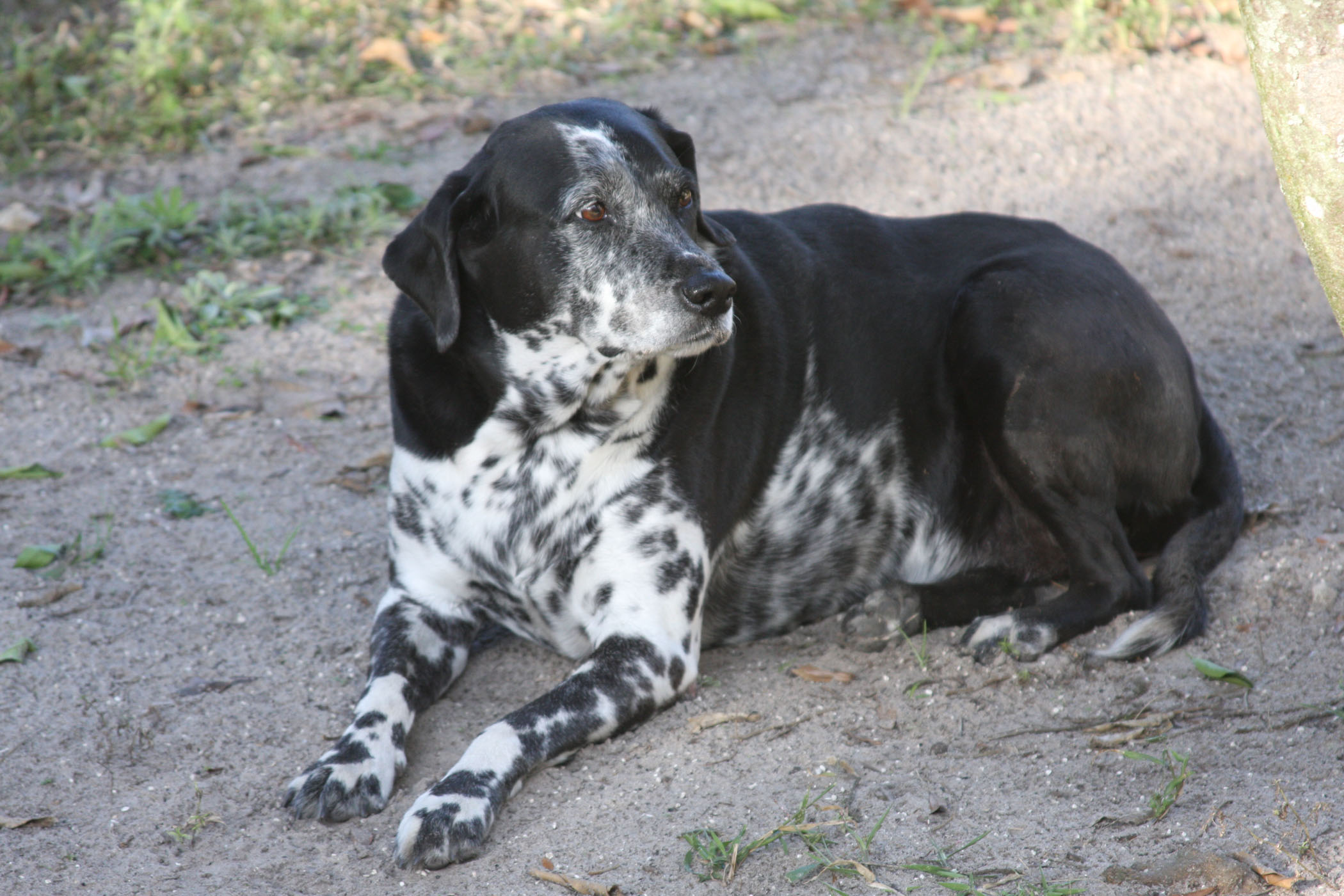
Dog days of summer are here. There is only one cure – grab your leash and water bowl and head for the beach!
Obi, a Welsh Corgi, and I did just that, winding our way down A1A south of St. Augustine, looking for a dog-friendly beach recommended by Brenda Flynn and her Scottish Terrier Pearl.
“It is a well kept secret, not even the locals know it is here,” said Flynn who lives in Ormond Beach. So secret we passed right by the street sign in Palm Coast for the turn because, silly me, I thought that there would be a dog beach sign. Hey, then it wouldn’t be a secret.
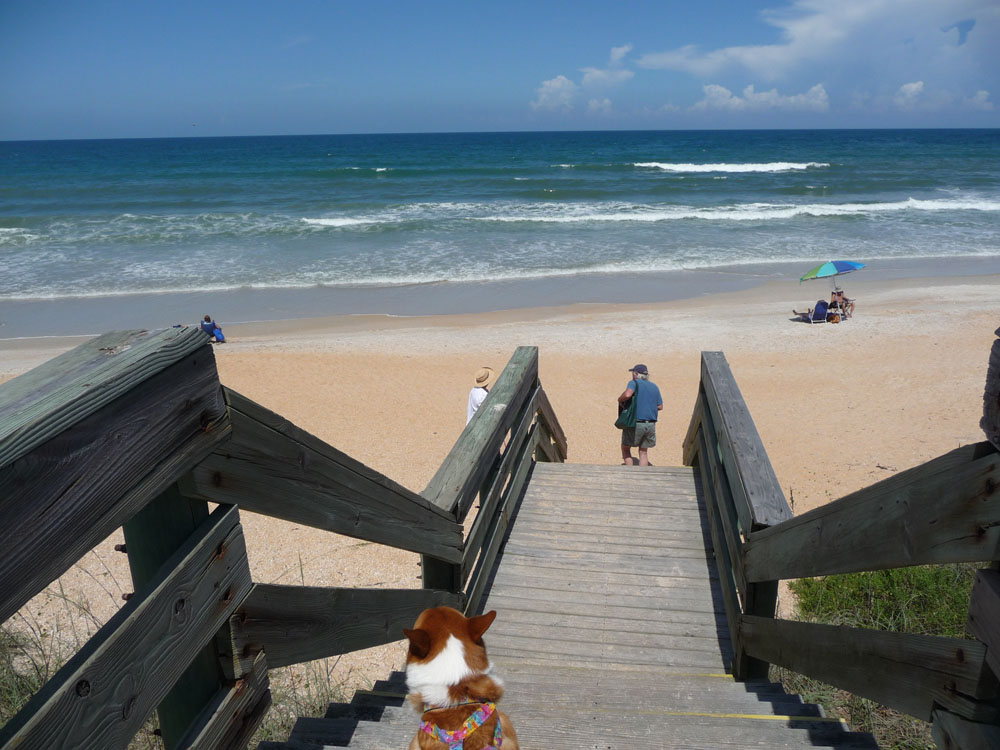
The street is named Jungle Hut Road. About half way down you cross a parkway that goes to Ginn Hammock Beach and Hammock Beach Vacation Rentals. Just stay on Jungle Hut until it ends. Surprise! Here is a public entrance to the beach with a paved parking lot, restroom, showers and a dune walkover. Very nice.
Leashed dogs are welcome. Clean up after your dog. Brenda is a regular here. She tells me low tide is the best time and in the evening, you are likely to see a dog coming down the steps from a waterfront home – carrying his leash in his mouth, his master trotting faithfully behind him.
Obi, urban dog that he is, quickly decided walking on hot sand was not his thing so naturally I carried him to the dune walkover. It is so nice have a dog small enough to pick up and sit in my lap. The sand by the water was much cooler.
Pearl thought the waves were wonderful and she liked Obi a lot, charging at him in the dog version of “let’s play!” He gave me that shocked look “Mom, the women are chasing me” and ran the other way. He got his feet wet at my encouragement but water wasn’t his thing.
We moved on to the Golden Lion Café in Flagler Beach. Dogs can sit outside the rail. Brenda, Per Hans and I sat at a table right next to the rail.
The fish taco was excellent, so were the onion rings. How sweet to smell salt air and look across the street to blue sky, white clouds and an ocean still clean, not yet spoiled by the oil spill.
Finding dog friendly beaches and dog parks in Florida is a challenge. Some are, some are not. Best to know ahead of time before venturing out. One good source is Florida Pets. Get on their E-mail list for regular updates on everything from places to play, restaurants that accept dogs and places to stay. Their motto: “They’re part of the family, so take them along!”
Another good resource is the Dog Lover’s Companion Guide to Florida by Sally Deneen and Robert McClure. This book is in its fourth edition.
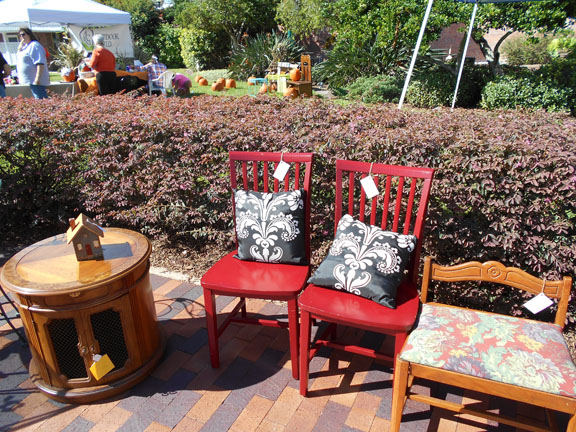
Some towns get two paws up for being dog friendly. Apalachicola comes to mind; here people even bring their dogs to work. Sanford puts out the welcome mat, or at least the water bowls. We found several water bowls at the Farmer’s Market on Saturday.
Do you know of more dog friendly places? Let me know in the “comment” section and we’ll post the places. Your best four-legged friend will be happy with new places to explore.
Lucy Beebe Tobias is the author ‘of “50 Great Walks in Florida” and a freelance Florida environmental writer.
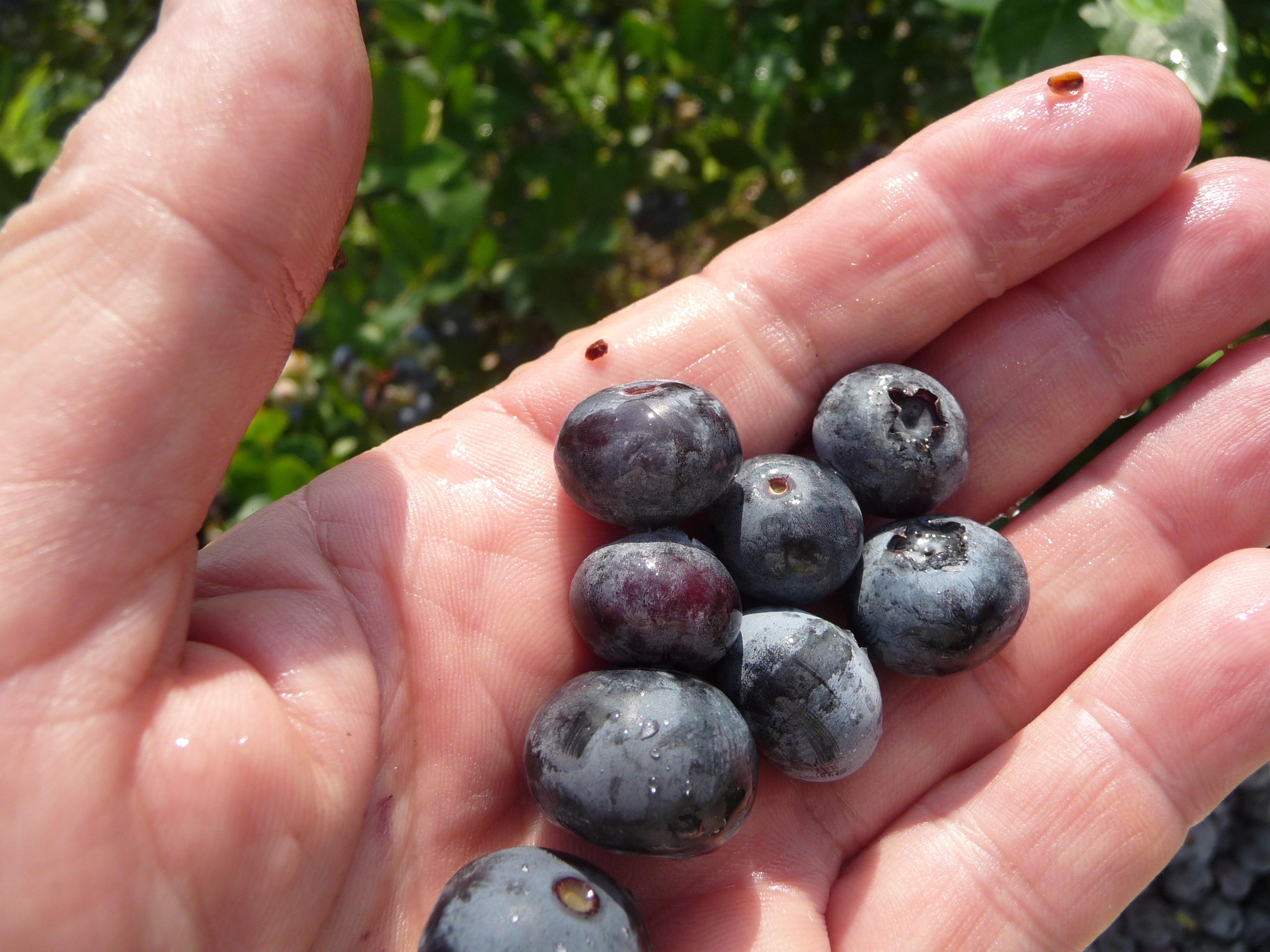
Yumm. June is here and that means the time has arrived to get it in gear and get out the buckets. They won’t be empty for long. This is the season to pick blueberries.
For my family and friends the taste of blueberries becomes extra sweet because we have a yearly ritual of gathering together to go on an adventure and pick blueberries. Somehow when you pick them yourself it improves the flavor.
To find a blueberry farm near you check out http://www.pickyourown.org This Web site lists all kinds of produce places to go in a number of states. Especially across Central Florida the list of blueberry farms is long. The ones that are organic have the word “organic” highlighted in green. We’ve picked organic blueberries at farms in both Marion and Alachua counties.
Picking blueberries is a prime time family affair and so is growing them. B&G Blueberries off County Road 315 past Silver Springs is a perfect example. “B” stands for Bill Hall and “G” stands for Gail Hall.
Here is what Bill said about how it all began:
“I started u-picking Rabbit Eye blueberries in 1983. At that time my two sons Danny and Jason were 12 and 7 and they assisted my mother Margaret Hall keeping the patch open Mon-Friday and Gail, Danny, Jason and I worked it on Saturday. My mother required the boys to pick 10 lbs. per day during the season.
Today their wives and six children are paid helpers on days we U-Pick. This year we spent a lot of time cross training the four older ones. There are six different jobs they do when we are open for u-pick. The six grand kids are ages 8 to 15. I always list them and their parents on the card we send to our customers.”
And here are their names – The Halls, Bill, Gail, Danny, Dorothy, Justin Micah, Rebekah, Ben, Jason, Robin, Savannah and EmmaLee. To get directions call (352) 236-4410 or Email: WDH47@embarqmail.com
Their picking dates in June are June 12, 18, 19, 25,26 and t hen July 3,5,10. Price is $2.50 per pound.
Close to Fort McCoy is the Bay Lake Blueberry Farm owned by Mike & Gail Waldron. This is a certified organic U pick and that means no pesticides! Good for your tummy, good for Mother Earth. The day we were there the Waldron’s daughters were helping customers carry their blueberries to the car and Gail’s mother in law was in charge of the cash register. Truly a family affair. Phone: 352-546-3834. Address: 20525 Highway 315, Ft. McCoy, Fl. and E mail: gwaldron1219@aol.com
In addition to picking blueberries Bay Lake has blueberry plants for sale along with local produce. We like to do this U pick early in the morning, then all go out for breakfast together. It is the food, fellowship and fun thing in action.
Live in Marion County? For more on picking blueberries in Marion County see the blog by Lucy Beebe Tobias and Sandra Friend entitled Ocala Adventures.
Now let’s get down to some specifics. Be an early riser for blueberry picking, so much easier in the cool of the day. Call ahead and find out when they open. Have the address and a map or use a GPS. Many farms are off the beaten path.
When you are there the farm supplies buckets for picking usually with rope so it can go around your waist and you have two hands free. Bring your own buckets in case you need them to put the berries in for the trip home.
Wear closed toed shoes for walking down the rows. A hat highly advised and bring water. Carry cash, this is not a credit card transaction. Most farms will have other things too – blueberry plants for sale, local produce and more.
This is a great inter-generational adventure. Various sizes of children work well with finding blueberries at different parts of the bushes (that can grow five six feet tall). Little ones pick the bottom, taller ones get the middle and adults find the ones on top.
Go for the fully ripe deep purple berries. Taste one before you start on a bush. If you like the flavor, that bush is for you. Pick them off one at a time. Don’t strip off unripe berries. It doesn’t take long to fill up a gallon bucket.
At home lay out paper towels and spread out the berries. Pick out any unripe ones. DO NOT wash them as they become mushy.
When any natural moisture has dried, bag them up a cup or two at a time and freeze. Set aside a good amount for yummy eating right now – straight, on cereal, in muffins, pie and even ice cream.
Here is Bill Hall’s favorite recipe for blueberry ice cream (one gallon)
2 pints blueberries
1 cup sugar
1 cup sweetened condensed milk
1 tablespoon vanilla
About ½ gallon whole milk
Take two pints blueberries, place in saucepan and cover with water. Add one cup of sugar and boil for five minutes. Let stand on stove until completely cooled. Strain directly into the churn cylinder. Pour remaining peels and liquid into blender. Blend then pour into churn cylinder. Add condensed milk and one tablespoon vanilla flavoring. Finish filling churn cylinder with whole milk. Sir and churn.
Ah, going to pick blueberries satisfies the prime ingredients for a good time – food, fellowship and fun. Grab your buckets and go!
Lucy Beebe Tobias is an author and writer. Her Web site is: http:www.LucyTobias.com
Are you up for the challenge?
April 24-25 from 10 a.m. to 5 p.m. is the Forgotten Coast Lighthouse Challenge. Visit Cape San Blas Lighthouse, Cape St. George Light, Crooked River Lighthouse and St. Mark’s Lighthouse. Tickets are $10 per person (over the age of 10) or $25 per family up to five people. All the lighthouses have tickets available. Receive a souvenir at each location and a special something if you climb or visit all four lighthouses.
Can’t remember where the Forgotten Coast is? Easy. Drop straight down south from Tallahassee until you run into the Gulf of Mexico. The coastline from Mexico Beach to Carrabelle is Florida’s Forgotten Coast.
Lighthouses are welcome sights for mariners, beacons in the night and day that make the difference between traveling safely or meeting an untimely demise. Did you know every lighthouse has its own color code pattern? By day a mariner can see the colors, look on his chart and know that location. The St. Augustine Lighthouse for example is painted in curving black and white stripes.
These tall structures, with spiraling stairs that make a gym Stairmaster look tame, are just plain cool. Climbing them is a challenge. Puff, take a break at landings, keep going, make it to the top and see an amazing 360 view.
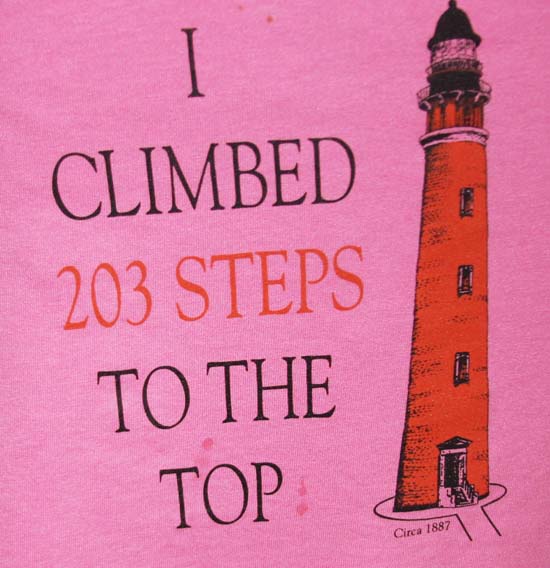
Here is a link to a Visit Florida video I did on climbing Ponce de Leon Lighthouse, Florida’s tallest lighthouse with 203 steps (one way). Make it back down and you are ready to buy the t-shirt!
The lights that pierce the darkness are creations of beauty. The Ponce de Leon Lighthouse has a museum with lighthouse keeper lore and examples of these Fresnel lights.
Many lighthouses are still active but now they are automated. The lighthouse keepers and their families are gone. When you visit a lighthouse gift shop look for a map you can buy called “Florida Lighthouses Illustrated Map & Guide. It is also available online at Bella Terra Maps. Price is $6.95 folded and $12.95 laminated. Keep this as a guide to your lighthouse adventures.
With three sides of Florida surrounded by water we have an abundance of lighthouses. There is even one inland. Mt. Dora has a working lighthouse. Built in 1988 standing 35 feet tall the blue pulsing light guides boaters on Lake Dora after dark.
The Florida Lighthouse Association helps preserve the historic lighthouses along Florida’s 1200-mile coastline and keep the magic of these tall towers alive. There is a state license plate available for purchase to help generate funds for restoring our lighthouses.
This group is gearing up for a change of ownership at one lighthouse. On April 21 at a 1 p.m. ceremony the Sanibel Lighthouse will pass hands from the Bureau of Land Management into ownership by the City of Sanibel.
Whether answering the lighthouse challenge or going to the lighthouse nearest you – Combine visiting lighthouses with sampling local seafood and you have the perfect recipe for a day trip.
©2010 Lucy Beebe Tobias, all rights reserved.
Breakfast at the Old Spanish Sugar Mill Restaurant inside DeLeon Springs State Park is an event. The tables have built in griddles. Our waitress showed us the button to turn on the griddle (gee, that was the hard part, it was on a table leg, we never would have found it).
As the griddle warmed, she brought coffee, big pitchers of home-milled pancake batters and the sides we’d chosen – blueberries and eggs. We began pouring batter, laughing, enjoying the moment, watching for the telltale bubbles that mean it is time to flip those pancakes.
Our table faced the windows. We looked out at DeLeon Springs headspring with its walled off swimming area and a waterfall spilling over boulders into Spring Garden Lake. This tranquil scene, with 19 million gallons of water a day coming from an underground cavern, empties its crystal clear water into Spring Garden Creek, then onto Lake Woodruff National Wildlife Refuge, the St. Johns River and eventually this water flows into the Atlantic Ocean. What a journey! And it begins here.
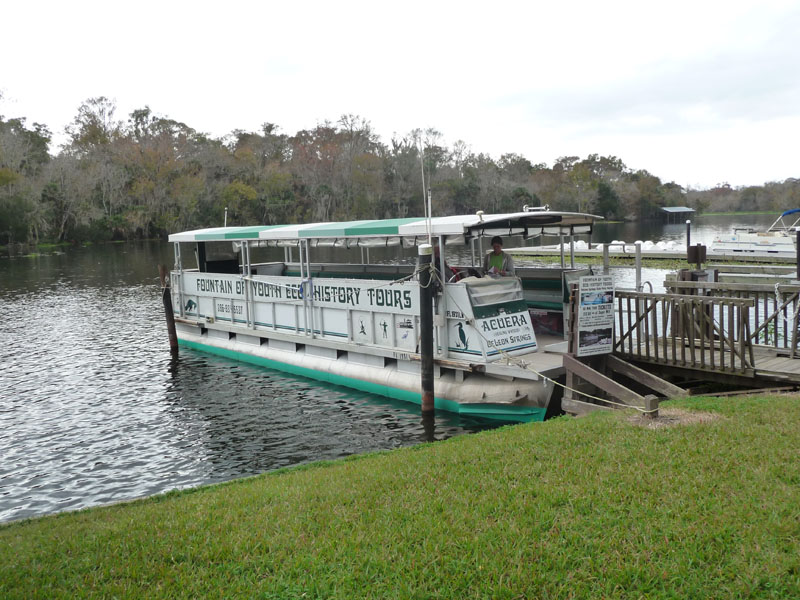
Tours leave at 10 a.m., 11 a.m., noon and 1 p.m. Tickets are $12. The narrated boat ride lasts 50 minutes, going down Spring Garden Creek and into Lake Woodruff National Wildlife Refuge. Reservations can be made at Sugar Mill or call the boat tour (386)-837-5537. To know more, visit the eco-tour’s Website.
BUT, and it is a big “but”, there must be a minimum of eight passengers for a tour to leave the dock. We were just two people ready for the 11 a.m. Apparently no one else wanted to leave the griddles.
So off we went to nearby DeLand, walking around downtown, visiting galleries, shops and museums. Captain Frank assured us he had 12 signed up for the 1 p.m. We returned (your park entrance receipt gets you back in all day) and boarded the M/V Acuera.
Captain Frank tells us Native Americans used to visit the springs 6,000 years ago. That was long before pancakes. In the early 1800′s Major Joseph Woodruff and his wife Jan bought 2,000 acres, grew sugar cane and indigo.
“He was the first to bring slaves to Florida,” Frank says.
There on the right – an anhinga and a great blue heron. On the left, snowy egrets and moor hens. An osprey sits high in a tree.
It is late fall, some color on the trees, most are bare.
“Come earlier in the fall for a brilliant change of color in the fall bright sunshine,” says Frank.
We see white ibis, lots of them, they were the sacred bird of Egypt.
Colonel Orlando Rees bought it in 1831 and made the earthen dam to power a sugar mill. Naturalist John James Audubon visited Rees in 1832 and Rees took him on a boat trip along the waterways, just like we are doing now. This is a great way to see birds. As we smoothly glide along, bird sighting are frequent. We also ask about plants.
Captain Frank points out smooth beggar tick – an unusual name – for yellow flowers blossoming by the water’s edge.
“This is old Florida, the way it looked for centuries, this is what the Spanish saw, what the Indians saw,” Frank says.
In the reeds an immature lack-crowned night heron and a female cormorant. We see an immature little blue heron – they are born white then turn blue in one to two years.
Alligators, big ones, sun themselves on the banks. Capt. Frank says they have 3,000 pounds of pressure in their jaws. We take his word for it.
A tri-colored heron is spotted in the shallows. Overhead a red-shouldered hawk flies by. A cooter turtle suns itself on a log.
We are floating in the Refuge now, some 20,000 acres of preserved land and water.
In the 1800s no highways existed. “The only roads were waterways, product was shipped by water, the only way to get to market,” says Captain Frank. He waves his hand outward. “It is 126 miles by water to Jacksonville. Steamboats came in the late 1820s, that is what really settled Florida from the center out, steam boat traffic, towns developed along the rivers and people came.”
And we come today to float in history’s wake, catch a glimpse of immature yellow crowned night herons and watch a kingfisher fly by. There are moments when you just have to say: “it doesn’t get any better than this.”
Short, narrated boat trips are a great way to see authentic Florida. We loved doing breakfast and a boat trip at DeLeon Springs and we’ll be back with family and friends.
Here are more possibilities:
A boat tour on the Wakulla River at Edward Ball Wakulla Springs State Park located southwest of Tallahassee. Upcoming tours include a photo tour on the Wakulla River on Saturday, Feb. 6 and a Valentine’s Cruise & Dinner on Saturday, Feb. 13.
A tour boat at Jonathan Dickinson State Park in Hobe Sound goes up the Loxahatchee River to Trapper Nelson’s homestead and a ranger-guided tour of the homestead.
A little more adventuresome – From Fort Myers, it is a three-hour (or more) catamaran ride to Key West on the Key West Boat Shuttle. Spend the day or two, return by boat.
Since seeing birds is such a big part of a river boat trip, I recommend a good field guide, particularly the Sibley Guide to Birds.

Pretty amazing that he illustrated every bird. I like the different views. A bird will fly overhead and all you see is the underside. Well, Sibley have those undersides.
©2009 Lucy Beebe Tobias, author of “50 Great Walks in Florida”.. All rights reserved.
We believe these truths to be self evident – cultural diversity makes us strong, celebrating our heritage keeps the past alive for future generations and when the Greeks are cooking, just show up. Amen.
That said – here are some places to go in Florida were cultural heritage is alive and well worth a visit. Tarpon Springs, 33 miles north of Tampa, started out in 1848. The town made a name as a winter resort for folks from up north who didn’t want to shovel snow.
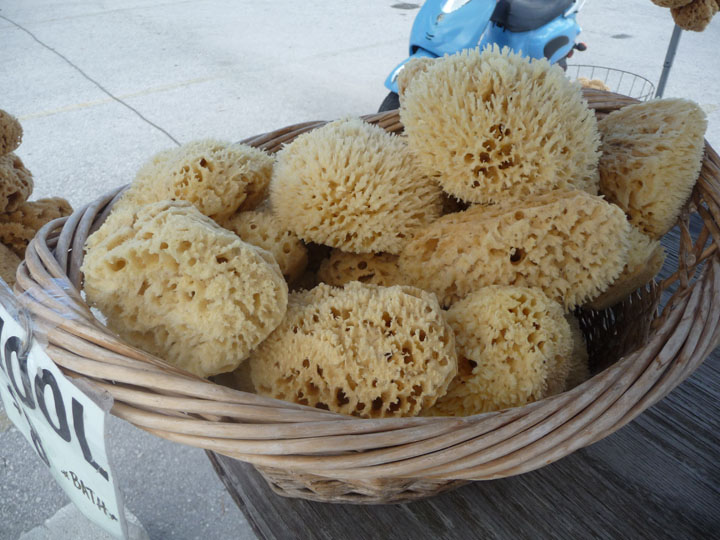
Then came the discovery in 1852 of sponges in the Gulf of Mexico. This was big news. Greece has sponge blight in its offshore waters and the industry was dying. Whole families came over to be spongers in America. They brought their culture and yes, their wonderful food.

The Sponge Docks still exist today. It is no accident that many restaurants line the sponge docks. When the boats came in, the crews were hungry. Pass the baklava please.
Take the shuttle bus that goes from the docks to downtown and be sure to tour the inside of St. Nicholas Greek Orthodox Cathedral.

Ybor City * used to be a swamp. Along came Martinez Ybor looking for a place to build a cigar factory. He thought his workers in Key West were getting too uppity and wanted to relocate. So he filled in the swamp and built his factory. Obviously those were the days before permits.

To keep his workers he built casitas, little attached houses, so cigar workers could sent for their families from Cuba. A casita cost $2500. The families came. Cuban culture still flourishes today. Have lunch at the original Columbia restaurant or try a Cuban at La Tropicana Café. Bueno. Other groups that came to work in the factories – Italians and Germans.
Speaking of Germans, Florida has a large German population in the southwest area but I’m not the only one who thinks the best German restaurant is up in Sanford, 23 miles northeast of Orlando.
Hollerback’s Willow Tree Café is a European style café and German restaurant that is family owned.. They know how to get to you. The day’s desserts are displayed in a case and you have to walk by . . .yum.
Well, what are we waiting for? Let’s go! Enjoy
* Ybor City is Chapter 35: Celebrate the Cigars in 50 Great Walks in Florida., Lucy Beebe Tobias, published by University Press of Florida, 2008
©2009 Lucy Beebe Tobias, all rights reserved.