The Florida Museum of Natural History in Gainesville wants you to see Florida’s natural beauty with fresh eyes. From Feb. 6 through April 25 the Quilters of Alachua County Day Guild have 100 original quilts on display in a juried show. You’ve never viewed Florida quite like this – beauty captured for all seasons in stitches and fabric.
Then you know, or have heard about, about Butterfly Rainforest attraction, an outdoor exhibit attached to the Museum. Wear bright clothing, especially red, and maybe butterflies will land on your clothes as you walk through their environment.
Inside the Museum are fossils galore, shark’s jaws, water stories, tales of Calusa Indians and you can even walk through time from the Eocene, 65 million years ago, to the Pleistocene when humans arrive 14,000 years ago (just yesterday!).
Why go visit the museum now? Say it with me – It is time for a change! We are in withdrawal from the Winter Olympics – what? No more curling? Plus, we are weary of winter, a cold season that has stayed on in Florida like an overripe house guest without the decency to leave.
Take charge, leave the house, go someplace with the thermostat set at 72 and a little on the wild side. I recommend the Florida Museum of Natural History. Admission is free and it is family friendly, making this museum my kind of place.
Just inside the entrance is a mastodon in the Central Gallery. Huge is an understatement. His tusks are thick, curved and look very fierce. Just his bones are on display but still, I’m very glad he is yesterday’s news and not coming soon to my neighborhood. His presence does however set the tone for a walk into the past as you go through the exhibits.
How easy it is to forget there was a Florida before Interstate 75. And what a vibrant, diverse heritage we have. The exhibits are clustered in permanent spaces.
Like sharks teeth? click to see a short video on shark jaws at Florida Museum
The exhibits put you in a different time and place. Watch water flow through a hardwood hammock and a limestone cave, see shark jaws so big you’ll reconsider going swimming, experience Indian village life and finally, my personal favorite, the Hall of Florida Fossils: Evolution of Life and Land. Who knew our history went back 65 million years? I did not. It was, and still is, fascinating news to me.

Museum hours are Monday – Saturday, 10-5 and Sunday 1-5. Address: University of Florida Cultural Plaza, SW 34th Street & Hull Road, Gainesville, phone (352) 846-2000. Closed Thanksgiving & Christmas. Website: http://www.flmnh.ufl.edu
A word about exhibits – the Museum is free. Special temporary exhibits, like the quilt show, charge admission, as does Butterfly Rainforest. The quilt show entitled “Quilting Natural Florida II” costs $6 adults, $5 Florida residents, $4.50 seniors and Florida college students and free for youth 17 and under and museum members.
Butterfly Rainforest prices are $9.50 adults, $8 Florida residents, $7 ages 62 and up, $5 ages 3-12. Last admission is 4:30 p.m.
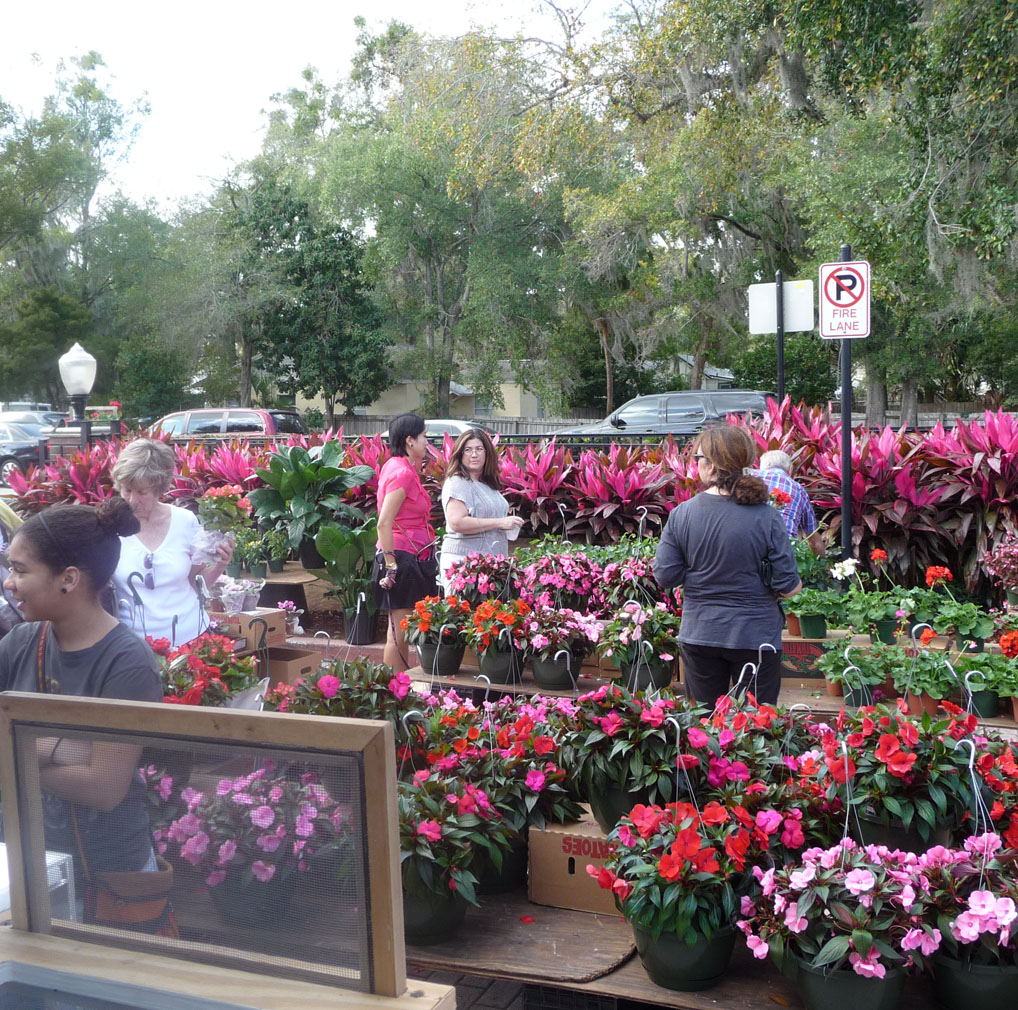
Every Saturday and Sunday Butterfly Rainforest sells butterfly-friendly plants, 10 plants each week plus an unannounced species. A list of what is on sale is under Plant Sales For example, the weekend of March 13-14 has Blanketflower, Blue eyed grass, Dianthus, Fetterbush, Impatiens, Passionflower, Lavender Lady, Plumbago, red, Sage, tropical, Sunshine Mimosa and Turkey Tangle Fogfruit.
March Museum events:
March 8, 10-11 Discover Hour for ages 2-8
March 20, 10-3 Can you dig it?
March 22, 10-11 Discovery Hour for ages 2-8
March 25, 7-9 p.m. Scott Sampson “Dinosaur Odyssey” Lecture & book signing.
March 27, 11-4 From “Vague” to Vision Quilt Workshop
Finally, I’d be remiss not to mention the big temptation just inside the front door – the Museum gift shop. Take a deep breath. Resist. Do the Museum first. The gift shop will still do its siren call to you on your way out.
Afterwards, should you not want to go home to dead plants and more freezing weather, just go next door to the Harn Museum of Art. Admission is free. Open Tuesday through Friday from 11-5, Saturday 10-5 and Sunday, 1-5. Closed Mondays and state holidays. In the basement is a delightful lunch spot, the Camellia Court Café open from 11-3.
—————————————————————————————————————————————————————-

NOTE: We are grateful to you, our subscribers, for following Saturday Morning Magazine and in appreciation we have a gift for you – a free booklet on getting started walking in Florida. Here is the link. Enjoy
Breakfast at the Old Spanish Sugar Mill Restaurant inside DeLeon Springs State Park is an event. The tables have built in griddles. Our waitress showed us the button to turn on the griddle (gee, that was the hard part, it was on a table leg, we never would have found it).
As the griddle warmed, she brought coffee, big pitchers of home-milled pancake batters and the sides we’d chosen – blueberries and eggs. We began pouring batter, laughing, enjoying the moment, watching for the telltale bubbles that mean it is time to flip those pancakes.
Our table faced the windows. We looked out at DeLeon Springs headspring with its walled off swimming area and a waterfall spilling over boulders into Spring Garden Lake. This tranquil scene, with 19 million gallons of water a day coming from an underground cavern, empties its crystal clear water into Spring Garden Creek, then onto Lake Woodruff National Wildlife Refuge, the St. Johns River and eventually this water flows into the Atlantic Ocean. What a journey! And it begins here.
Tours leave at 10 a.m., 11 a.m., noon and 1 p.m. Tickets are $12. The narrated boat ride lasts 50 minutes, going down Spring Garden Creek and into Lake Woodruff National Wildlife Refuge. Reservations can be made at Sugar Mill or call the boat tour (386)-837-5537. To know more, visit the eco-tour’s Website.
BUT, and it is a big “but”, there must be a minimum of eight passengers for a tour to leave the dock. We were just two people ready for the 11 a.m. Apparently no one else wanted to leave the griddles.
So off we went to nearby DeLand, walking around downtown, visiting galleries, shops and museums. Captain Frank assured us he had 12 signed up for the 1 p.m. We returned (your park entrance receipt gets you back in all day) and boarded the M/V Acuera.
Captain Frank tells us Native Americans used to visit the springs 6,000 years ago. That was long before pancakes. In the early 1800’s Major Joseph Woodruff and his wife Jan bought 2,000 acres, grew sugar cane and indigo.
“He was the first to bring slaves to Florida,” Frank says.
There on the right – an anhinga and a great blue heron. On the left, snowy egrets and moor hens. An osprey sits high in a tree.
It is late fall, some color on the trees, most are bare.
“Come earlier in the fall for a brilliant change of color in the fall bright sunshine,” says Frank.
We see white ibis, lots of them, they were the sacred bird of Egypt.
Colonel Orlando Rees bought it in 1831 and made the earthen dam to power a sugar mill. Naturalist John James Audubon visited Rees in 1832 and Rees took him on a boat trip along the waterways, just like we are doing now. This is a great way to see birds. As we smoothly glide along, bird sighting are frequent. We also ask about plants.
Captain Frank points out smooth beggar tick – an unusual name – for yellow flowers blossoming by the water’s edge.
“This is old Florida, the way it looked for centuries, this is what the Spanish saw, what the Indians saw,” Frank says.
In the reeds an immature lack-crowned night heron and a female cormorant. We see an immature little blue heron – they are born white then turn blue in one to two years.
Alligators, big ones, sun themselves on the banks. Capt. Frank says they have 3,000 pounds of pressure in their jaws. We take his word for it.
A tri-colored heron is spotted in the shallows. Overhead a red-shouldered hawk flies by. A cooter turtle suns itself on a log.
We are floating in the Refuge now, some 20,000 acres of preserved land and water.
In the 1800s no highways existed. “The only roads were waterways, product was shipped by water, the only way to get to market,” says Captain Frank. He waves his hand outward. “It is 126 miles by water to Jacksonville. Steamboats came in the late 1820s, that is what really settled Florida from the center out, steam boat traffic, towns developed along the rivers and people came.”
And we come today to float in history’s wake, catch a glimpse of immature yellow crowned night herons and watch a kingfisher fly by. There are moments when you just have to say: “it doesn’t get any better than this.”
Short, narrated boat trips are a great way to see authentic Florida. We loved doing breakfast and a boat trip at DeLeon Springs and we’ll be back with family and friends.
Here are more possibilities:
A boat tour on the Wakulla River at Edward Ball Wakulla Springs State Park located southwest of Tallahassee. Upcoming tours include a photo tour on the Wakulla River on Saturday, Feb. 6 and a Valentine’s Cruise & Dinner on Saturday, Feb. 13.
A tour boat at Jonathan Dickinson State Park in Hobe Sound goes up the Loxahatchee River to Trapper Nelson’s homestead and a ranger-guided tour of the homestead.
A little more adventuresome – From Fort Myers, it is a three-hour (or more) catamaran ride to Key West on the Key West Boat Shuttle. Spend the day or two, return by boat.
Since seeing birds is such a big part of a river boat trip, I recommend a good field guide, particularly the Sibley Guide to Birds.

Pretty amazing that he illustrated every bird. I like the different views. A bird will fly overhead and all you see is the underside. Well, Sibley have those undersides.
©2009 Lucy Beebe Tobias, author of “50 Great Walks in Florida”.. All rights reserved.
We believe these truths to be self evident – cultural diversity makes us strong, celebrating our heritage keeps the past alive for future generations and when the Greeks are cooking, just show up. Amen.
That said – here are some places to go in Florida were cultural heritage is alive and well worth a visit. Tarpon Springs, 33 miles north of Tampa, started out in 1848. The town made a name as a winter resort for folks from up north who didn’t want to shovel snow.
Then came the discovery in 1852 of sponges in the Gulf of Mexico. This was big news. Greece has sponge blight in its offshore waters and the industry was dying. Whole families came over to be spongers in America. They brought their culture and yes, their wonderful food.

The Sponge Docks still exist today. It is no accident that many restaurants line the sponge docks. When the boats came in, the crews were hungry. Pass the baklava please.
Take the shuttle bus that goes from the docks to downtown and be sure to tour the inside of St. Nicholas Greek Orthodox Cathedral.

Ybor City * used to be a swamp. Along came Martinez Ybor looking for a place to build a cigar factory. He thought his workers in Key West were getting too uppity and wanted to relocate. So he filled in the swamp and built his factory. Obviously those were the days before permits.

To keep his workers he built casitas, little attached houses, so cigar workers could sent for their families from Cuba. A casita cost $2500. The families came. Cuban culture still flourishes today. Have lunch at the original Columbia restaurant or try a Cuban at La Tropicana Café. Bueno. Other groups that came to work in the factories – Italians and Germans.
Speaking of Germans, Florida has a large German population in the southwest area but I’m not the only one who thinks the best German restaurant is up in Sanford, 23 miles northeast of Orlando.
Hollerback’s Willow Tree Café is a European style café and German restaurant that is family owned.. They know how to get to you. The day’s desserts are displayed in a case and you have to walk by . . .yum.
Well, what are we waiting for? Let’s go! Enjoy
* Ybor City is Chapter 35: Celebrate the Cigars in 50 Great Walks in Florida., Lucy Beebe Tobias, published by University Press of Florida, 2008
©2009 Lucy Beebe Tobias, all rights reserved.
When I go to book presentations and signings for “50 Great Walks in Florida” the most asked question is: “What is your favorite walk?”
Each one is different. I love them all. As proof, I’d do them all again in a heartbeat. I did 80 walks and the 50 great ones made the cut.
But I always do ask the audience if they have children and grandchildren. Do you? If the answer is “yes” then open your 50 Great Walks to Chapter 30: Guided Nighttime Turtle Walk, Archie Carr National Wildlife Refuge, Vero Beach.
June and July are nesting season for loggerhead turtles. Starting May 15 at 8 a.m. Sebastian Inlet State Park will begin taking reservations for June walks. Be sitting by the phone. These spots go fast. July’s reservations will be taken starting June 15 at 8 a.m. The number is 772-388-2750.
Another choice: Sea World @ Vero Beach. They too start taking reservations on May 15 at 8 a.m. for June. The phone number is the same 772-388-2750.
Why this walk? Two reasons: I am often asked “What is there to do in the summer in Florida”. Here’s an answer. And, while you may or may not see a turtle laying eggs the night you go, if you do it is a once-in-a-lifetime experience. Your evening starts late, after dark, with a movie about turtles then patrols go on the beach looking for nesting loggerheads. If they find one, you all walk down the beach to the site. (My recommendation: do not wear flip-flops).
On our nighttime walk, we went to a turtle laying eggs and stood behind her. The children were asked to come up close, get down on the sand and watch her lay eggs, something turtles have done for millions of years. I stood in the back with the adults and I’m not ashamed to say, I cried. It was beautiful, ancient, moving and solid proof that everything on Mother Earth is connected. What we do matters, like not throwing plastic bags on the beach or in the water. A turtle might eat it (looks like a jellyfish) and die of starvation as the plastic stays in their stomach.
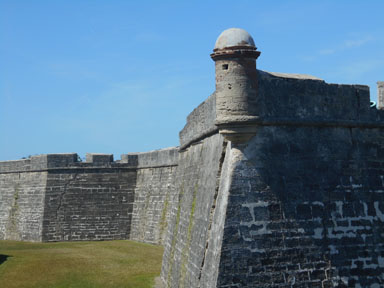
Memorial Day weekend happens in May and the weekend is well displayed at Fort Clinch State Park in Fernandina Beach. They have a World War II Event from 9 a.m. to 5 p.m. on Saturday, May 23 and from 9 a.m. to noon on Sunday May 24. Featured are military displays and memorabilia of the Allies, Axis and Home front.

Getting ready for guided Willow Pond Walk at Fort Clinch State Park
Stay and do the two walks in 50 Great Walks – Ch. 11: A Stroll Through History: The Historic Downtown Fernandina Beach Centre Street Stroll (whew! That’s a mouthful) and Ch. 12: Nature’s Classroom: Willow Pond Nature Trail, Fort Clinch State Park.
Finish up May in beautiful DeLand (Ch. 25: Painted History Walk). 
On Saturday, May 30 there is a nature hike at Bicentennial Youth Park about reading skulls and bones of animals. Gregg Thompson, biologist and naturalist, will share his extensive skull collection. Cool! Call 386-668-5553.
So, now you know my confession – I cry in the face of beauty and it is not just with turtles. Want to see something beautiful? Bok Tower Gardens near Lake Wales redesigned their Web site and it is a thing of beauty, especially the photographs. Take a look at Bok Tower Gardens.
Lucy Beebe Tobias is the author of “50 Great Walks in Florida” and the Authentic Florida Expert for VISIT FLORIDA.
One day the birds complained to the Great Father
“Why did you make butterflies so beautiful? We feel left out.”
“What would you have me do?” God asked.
“Give them a flaw,” the birds said.
“Well, how about I make them silent,” the Great Father said and so it is that butterflies have no mouths. The birds went away pleased.
But in the fullness of time they returned to complain again.
“Why is it all the butterflies come to visit you?”
“Because,” God said, “I am the only one who understands them and they come to talk to me.”
That is why you can make a prayer, make a wish, send it with a butterfly and it will go straight to God. No one else will hear it.
Samuel Woodham, a tour guide at Greathouse Butterfly Farm, loves telling that American Indian story.
Greathouse is on State Road 26, 15 miles east of Gainesville, two miles past 301. As soon as you go through the light for CR 1469, you will see the Greathouse Butterfly Farm sign on your right followed shortly by a driveway into a large parking lot. It is two miles west of Melrose.
The butterfly farm raises 45 species of Florida butterflies in long greenhouses. There is a garden plant section with butterfly plants for sale, an extensive garden area showing plantings to attract butterflies, a gift shop located inside an old family farmhouse and daily tours of the grounds and the greenhouses.
Tours are at 10 a.m. and 2 p.m. seven days a week and last about an hour to an hour and a half. No reservations necessary. The fee for adults is $8, children and seniors $6.
The tour starts with a video explaining a butterfly’s life and then moves outdoors.
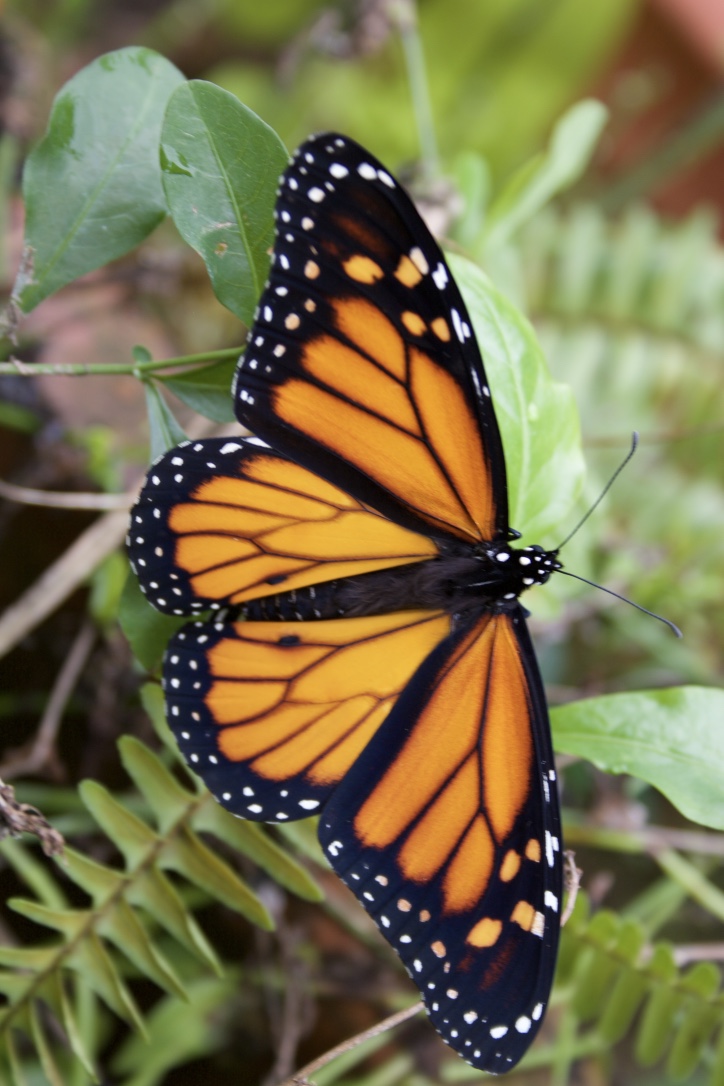
On sunny days it looks like wild butterflies have Greathouse marked with a huge X on their internal roadmaps. As we take the tour through winding garden paths, zebra longwings, the state butterfly, zip by. Monarch butterflies, bright orange wings with black markings, feed on flowers and lay eggs on milkweed. Butterflies of many colors and names unknown to me, fly by, taste a flower and photographers snap away.
If you ever wanted these winged wonders in your yard, a Greathouse tour provides a visual introduction to what it takes, plus just walking through the gardens is a delight.
Butterflies like fast food – the nectar in flowers like salvia and butterfly bush. They also need host plants – certain plants for different species to be used as hosts to lay eggs. Some examples: milkweed for monarchs and passion vine for zebra longwings.
Haven’t seen any butterflies around your area? It could be more than a lack of host and nectar plants. Butterflies are a good judge of how an ecological system is doing. They are defenseless against pesticides, so gardeners who use them would have to change their habits to accommodate butterflies.
Zane Greathouse started the farm after his student experiments turned into a fulltime job. A fifth grade science teacher in Gainesville, Zane wanted his classes to have a hands on experience with animals, but not the frog dissection or the token guinea pig living in the back of the classroom.
So he went for insects and brought in crystallis that were ready to hatch. Students were each given one and asked not to talk, just write and draw their experiences. All day long the butterflies emerged and flew around the room.
It didn’t take long before word got around and Zane was doing the same lesson all over the country. An old family farm, built before the Civil War, became Greathouse Butterfly Farm.
In the greenhouses thousands of butterflies are grown for shipments to botanical gardens, wedding releases, memorial services and other events.
After the tour, a few of us linger. Will a butterfly listen to our wishes? We go back down the garden path to give it a try.
If you go
What: Greathouse Butterfly Farm, Inc.
Where: 20329 State Road 26 East, Melrose, Fl 32631
Phone: toll free (866) 457-2088
Website: www.greathousebutterflyfarm.com
E-mail: butterflies@greathousebutterflyfarm.com
Closed: July 4th, Labor Day, Thanksgiving and Christmas
Reprinted with permission from the Observer newspaper. Lucy Beebe Tobias is a freelance writer, artist and photographer in Ocala, Florida. E mail: Lucy@lucyworks.com