Currently Browsing: parks

Loving the Levees in Florida

Levees are elevated structures built by U.S. Army Corps of Engineers to impound and hold back high water.

Building levees causes “unintended consequences” as they like to say in political speak. The “unintended consequences” in this case turn out to be good for you and me.

Consider the levee – lots of dirt piled at least six feet high and oh, say eight feet wide or more. The top of the level is flat.
There it is, the “unintended consequence” – turns out that flat, high surface is a great place to walk or ride bikes or watch birds.

Birders love levees because the sight lines are so great. Winter birds come to hang out in the waters impounded by levees. Birders use levees as their own elevated viewing platform, at least six feet about the water.

In the wintertime at St. Marks National Wildlife Refuge south of Tallahassee, drive down Lighthouse Road and see all the birding scopes set up on tripods along the levees.

St. Marks levee

St. Marks is a classic levee story. Walk down the Mounds Trail (chapter 7 in my book “50 Great Walks in Florida”) and find Marker No. 2. It is on a tree, about five feet up, showing how high the water rose on Sept. 13, 1843. The Hurricane of 1843 wiped out the nearby towns of St. Marks River, Magnolia, Rock Haven and Port Leon. Today the refuge has a LOT of levees.

A specially designated levee trail starts at the end of Lighthouse Road. It is one-half mile long, with free leaflets at the start. Travel the trail on foot, on bike or by horseback.

Walkers like me like levees because I don’t like surprises, say wildlife crossing the road or a snake sunning itself. I prefer my wildlife viewing from a distance and distance (good sight lines) is exactly what you have on levees.

Levee at Sunnyhill. Note sandill cranes in middle

At Sunnyhill Restoration Area, St. Johns River Water Management District, located in southeast Marion County, sandhill cranes may join you on your levee walk. That happened to me. Their attitude was “What took you so long? We’ve been expecting you.” And so we walked together. Sandhill cranes like this area and tend to stay year round. Ch. 28 in 50 Great Walks is titled “Walking with Friends” about the Sunnyhill Restoration Area.

Sandhill cranes at Sunnyhill

There is one down side to levees – no shade. The tops are mowed. No trees grow here.

That said, now you know to bring a hat with a wide brim and carry lots of water for your levee walk.

Another good place for levee walking is Arthur R. Loxahatchee National Wildlife Refuge in Boynton Beach. This area is also a gateway for the Great Florida Birding Trail.

The big daddy of levee walks in Florida is the Lake Okeechobee Scenic Trail with the unfortunate acronym of LOST. Some 113 miles of LOST encircle Lake Okeechobee with gaps where the walker has to come down from the levee, and then get back up at a later point.

This levee is along the 35-foot high Herbert Hoover Dike. Surfaces are crushed gravel, some paved asphalt.
Once a year the Loxahatchee Chapter of the Florida Trail Association hosts the Big O Hike, a week of going around the lake. This year’s dates are Nov. 20-28, 2010.

Springtime is the perfect time for walking levees – cool, sunlit days with lots of breezes and no bugs or humidity. See you on the levee.

©2010 Lucy Beebe Tobias, all rights reserved

Take a Boat Ride in History’s Wake

Breakfast at the Old Spanish Sugar Mill Restaurant inside DeLeon Springs State Park is an event. The tables have built in griddles. Our waitress showed us the button to turn on the griddle (gee, that was the hard part, it was on a table leg, we never would have found it).

As the griddle warmed, she brought coffee, big pitchers of home-milled pancake batters and the sides we’d chosen – blueberries and eggs. We began pouring batter, laughing, enjoying the moment, watching for the telltale bubbles that mean it is time to flip those pancakes.

flipping pancakes

Barbara Fitos flipping pancakes

Our table faced the windows. We looked out at DeLeon Springs headspring with its walled off swimming area and a waterfall spilling over boulders into Spring Garden Lake. This tranquil scene, with 19 million gallons of water a day coming from an underground cavern, empties its crystal clear water into Spring Garden Creek, then onto Lake Woodruff National Wildlife Refuge, the St. Johns River and eventually this water flows into the Atlantic Ocean. What a journey! And it begins here.

sugar mill and waterfall

sugar mill and waterfall


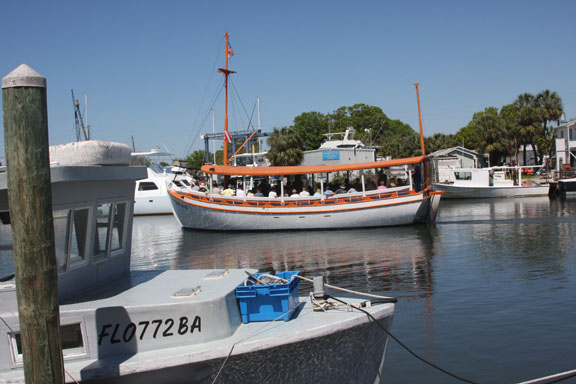
Across the way sat M.V Acuera, a 28-seat pontoon boat with a canvas roof cover. On the sides it says Fountain of Youth ECO/History Tours. Our plan: first, enjoy breakfast, and then take a boat trip. It worked but not quite the way we’d envisioned.

P1010296

Tours leave at 10 a.m., 11 a.m., noon and 1 p.m. Tickets are $12. The narrated boat ride lasts 50 minutes, going down Spring Garden Creek and into Lake Woodruff National Wildlife Refuge. Reservations can be made at Sugar Mill or call the boat tour (386)-837-5537. To know more, visit the eco-tour’s Website.

BUT, and it is a big “but”, there must be a minimum of eight passengers for a tour to leave the dock. We were just two people ready for the 11 a.m. Apparently no one else wanted to leave the griddles.

So off we went to nearby DeLand, walking around downtown, visiting galleries, shops and museums. Captain Frank assured us he had 12 signed up for the 1 p.m. We returned (your park entrance receipt gets you back in all day) and boarded the M/V Acuera.

Captain Frank tells us Native Americans used to visit the springs 6,000 years ago. That was long before pancakes. In the early 1800′s Major Joseph Woodruff and his wife Jan bought 2,000 acres, grew sugar cane and indigo.

“He was the first to bring slaves to Florida,” Frank says.

There on the right – an anhinga and a great blue heron. On the left, snowy egrets and moor hens. An osprey sits high in a tree.

osprey in a tree

osprey in a tree

It is late fall, some color on the trees, most are bare.
“Come earlier in the fall for a brilliant change of color in the fall bright sunshine,” says Frank.

We see white ibis, lots of them, they were the sacred bird of Egypt.

Colonel Orlando Rees bought it in 1831 and made the earthen dam to power a sugar mill. Naturalist John James Audubon visited Rees in 1832 and Rees took him on a boat trip along the waterways, just like we are doing now. This is a great way to see birds. As we smoothly glide along, bird sighting are frequent. We also ask about plants.

Captain Frank points out smooth beggar tick – an unusual name – for yellow flowers blossoming by the water’s edge.

“This is old Florida, the way it looked for centuries, this is what the Spanish saw, what the Indians saw,” Frank says.

P1010288

River views

River views

In the reeds an immature lack-crowned night heron and a female cormorant. We see an immature little blue heron – they are born white then turn blue in one to two years.

Alligators, big ones, sun themselves on the banks. Capt. Frank says they have 3,000 pounds of pressure in their jaws. We take his word for it.

A tri-colored heron is spotted in the shallows. Overhead a red-shouldered hawk flies by. A cooter turtle suns itself on a log.

We are floating in the Refuge now, some 20,000 acres of preserved land and water.

In the 1800s no highways existed. “The only roads were waterways, product was shipped by water, the only way to get to market,” says Captain Frank. He waves his hand outward. “It is 126 miles by water to Jacksonville. Steamboats came in the late 1820s, that is what really settled Florida from the center out, steam boat traffic, towns developed along the rivers and people came.”

And we come today to float in history’s wake, catch a glimpse of immature yellow crowned night herons and watch a kingfisher fly by. There are moments when you just have to say: “it doesn’t get any better than this.”

Short, narrated boat trips are a great way to see authentic Florida. We loved doing breakfast and a boat trip at DeLeon Springs and we’ll be back with family and friends.

Here are more possibilities:

A boat tour on the Wakulla River at Edward Ball Wakulla Springs State Park located southwest of Tallahassee. Upcoming tours include a photo tour on the Wakulla River on Saturday, Feb. 6 and a Valentine’s Cruise & Dinner on Saturday, Feb. 13.

A tour boat at Jonathan Dickinson State Park in Hobe Sound goes up the Loxahatchee River to Trapper Nelson’s homestead and a ranger-guided tour of the homestead.

A little more adventuresome – From Fort Myers, it is a three-hour (or more) catamaran ride to Key West on the Key West Boat Shuttle. Spend the day or two, return by boat.

Since seeing birds is such a big part of a river boat trip, I recommend a good field guide, particularly the Sibley Guide to Birds.
P1010311

Pretty amazing that he illustrated every bird. I like the different views. A bird will fly overhead and all you see is the underside. Well, Sibley have those undersides.

©2009 Lucy Beebe Tobias, author of “50 Great Walks in Florida”.. All rights reserved.

What’s Happening at 50 Great Walks in May

When I go to book presentations and signings for “50 Great Walks in Florida” the most asked question is: “What is your favorite walk?”

Each one is different. I love them all. As proof, I’d do them all again in a heartbeat. I did 80 walks and the 50 great ones made the cut.

But I always do ask the audience if they have children and grandchildren. Do you? If the answer is “yes” then open your 50 Great Walks to Chapter 30: Guided Nighttime Turtle Walk, Archie Carr National Wildlife Refuge, Vero Beach.

June and July are nesting season for loggerhead turtles. Starting May 15 at 8 a.m. Sebastian Inlet State Park will begin taking reservations for June walks. Be sitting by the phone. These spots go fast. July’s reservations will be taken starting June 15 at 8 a.m. The number is 772-388-2750.

Another choice: Sea World @ Vero Beach. They too start taking reservations on May 15 at 8 a.m. for June. The phone number is the same 772-388-2750.

Why this walk? Two reasons: I am often asked “What is there to do in the summer in Florida”. Here’s an answer. And, while you may or may not see a turtle laying eggs the night you go, if you do it is a once-in-a-lifetime experience. Your evening starts late, after dark, with a movie about turtles then patrols go on the beach looking for nesting loggerheads. If they find one, you all walk down the beach to the site. (My recommendation: do not wear flip-flops).

On our nighttime walk, we went to a turtle laying eggs and stood behind her. The children were asked to come up close, get down on the sand and watch her lay eggs, something turtles have done for millions of years. I stood in the back with the adults and I’m not ashamed to say, I cried. It was beautiful, ancient, moving and solid proof that everything on Mother Earth is connected. What we do matters, like not throwing plastic bags on the beach or in the water. A turtle might eat it (looks like a jellyfish) and die of starvation as the plastic stays in their stomach.

Memorial Day weekend happens in May and the weekend is well displayed at Fort Clinch State Park in Fernandina Beach. They have a World War II Event from 9 a.m. to 5 p.m. on Saturday, May 23 and from 9 a.m. to noon on Sunday May 24. Featured are military displays and memorabilia of the Allies, Axis and Home front.

Getting ready for guided Willow Pond Walk at Fort Clinch State Park

Getting ready for guided Willow Pond Walk at Fort Clinch State Park

Stay and do the two walks in 50 Great Walks – Ch. 11: A Stroll Through History: The Historic Downtown Fernandina Beach Centre Street Stroll (whew! That’s a mouthful) and Ch. 12: Nature’s Classroom: Willow Pond Nature Trail, Fort Clinch State Park.

Finish up May in beautiful DeLand (Ch. 25: Painted History Walk). img_0547

On Saturday, May 30 there is a nature hike at Bicentennial Youth Park about reading skulls and bones of animals. Gregg Thompson, biologist and naturalist, will share his extensive skull collection. Cool! Call 386-668-5553.

So, now you know my confession – I cry in the face of beauty and it is not just with turtles. Want to see something beautiful? Bok Tower Gardens near Lake Wales redesigned their Web site and it is a thing of beauty, especially the photographs. Take a look at Bok Tower Gardens.

Lucy Beebe Tobias is the author of “50 Great Walks in Florida” and the Authentic Florida Expert for VISIT FLORIDA.

Five Fun Things to Do in April

Ah, spring. Open the windows. Let in fresh air. Inhale.

Makes you restless, doesn’t it? Have I got a cure for you – five fun events for April all happening in places from my book “50 Great Walks in Florida.”

Chapter 1: The Joys of Meandering: Alfred B. Maclay Gardens State Park, Tallahassee.
Saturday, April 5 at the Gardener’s Cottage from 3-5 p.m. is a program on spring arrangements for your Easter table. Program is free with park admission.

And did you know that every Monday you could volunteer to work in the gardens and the greenhouse and learn gardening techniques? Call 850-487-4115 to let them know you are coming.

Chapter 13: Traverse Two Terrains: Little Talbot Island State Park, Jacksonville.

Beach at Little Talbot Island State Park

Saturday, April 11 at 1 p .m. join a park ranger for a talk on shark’s teeth and the kinds found on the area’s beaches. Also check their Web site for ranger-led nature and beach walks.

Chapter 29: Garden of Delights; Harry P. Leu Gardens, Orlando.
Friday, April 3 is Date Night at the Gardens. Gardens open at 6 p.m. and a movie “Mama Mia” shows at 8:30 p.m. Bring a blanket or chairs and dinner picnic basket. Admission $7 plus tax for adults and $2 plus tax for children.

Hibiscus in bloom

Come back on Saturday, April 11 for their Hibiscus Show and Sale. The Plant sale starts at 9 a.m. and a hibiscus show runs from 1-5 p.m. Free admission to the show. Expert advice on taking care of your hibiscus from the Central Florida Hibiscus Society.

Chapter 33: “Gardens, Landscapes, and Native Habitats: Florida Botanical Gardens, Largo.
Celebrate Earth Day on April 18. From 9 a.m. to 1 p.m. admission and parking is free. The usual produce and products with their Saturday Market in the Park will be there plus exhibits and experts to share easy ways to protect Mother Earth.

Come early. The first 60 participants receive a free native oak tree.

Chapter 36: Mangroves, Orchids, and a Bo Tree: Marie Selby Botanical Gardens, Sarasota.

Walkway at Marie Selby Botanical Gardens

Through April 18 is an exhibit and sale called Rainforest Masks featuring master carvers from an indigenous reserve next to a rainforest in Costa Rica.
Visit on a Sunday afternoon and hear live music in the gardens from 1-3 p.m. On Sunday, April 5 music is by the Swing Merchants.

So, fill up the gas tank – go forth and enjoy. Oh, yes, and take 50 Great Walks with you!

Copyright 2009 Lucy Beebe Tobias. Lucy is the Authentic Florida expert for VISIT FLORIDA and the author of 50 Great Walks in Florida, University Press of Florida