Currently Browsing: What’s New?

A Place of Enchantment

She often started her day on the front porch. A small manual typewriter awaited her words. But I like to imagine Marjorie Kinnan Rawlings ignored the typewriter at first. I picture her comfortable in her chair at the big round wood table, coffee mug in hand, easing into the morning routine one sip at a time.

Marjorie inhaled the fragrance of orange blossoms right outside her front door and worried how she was going to afford living in her piece of paradise.

And worry she did. We forget that part. At the beginning of her Cross Creek years Rawlings was not rich and famous. She had not yet written “Cross Creek” or won the 1939 Pulitzer Prize for “The Yearling” – a book written on this very porch.

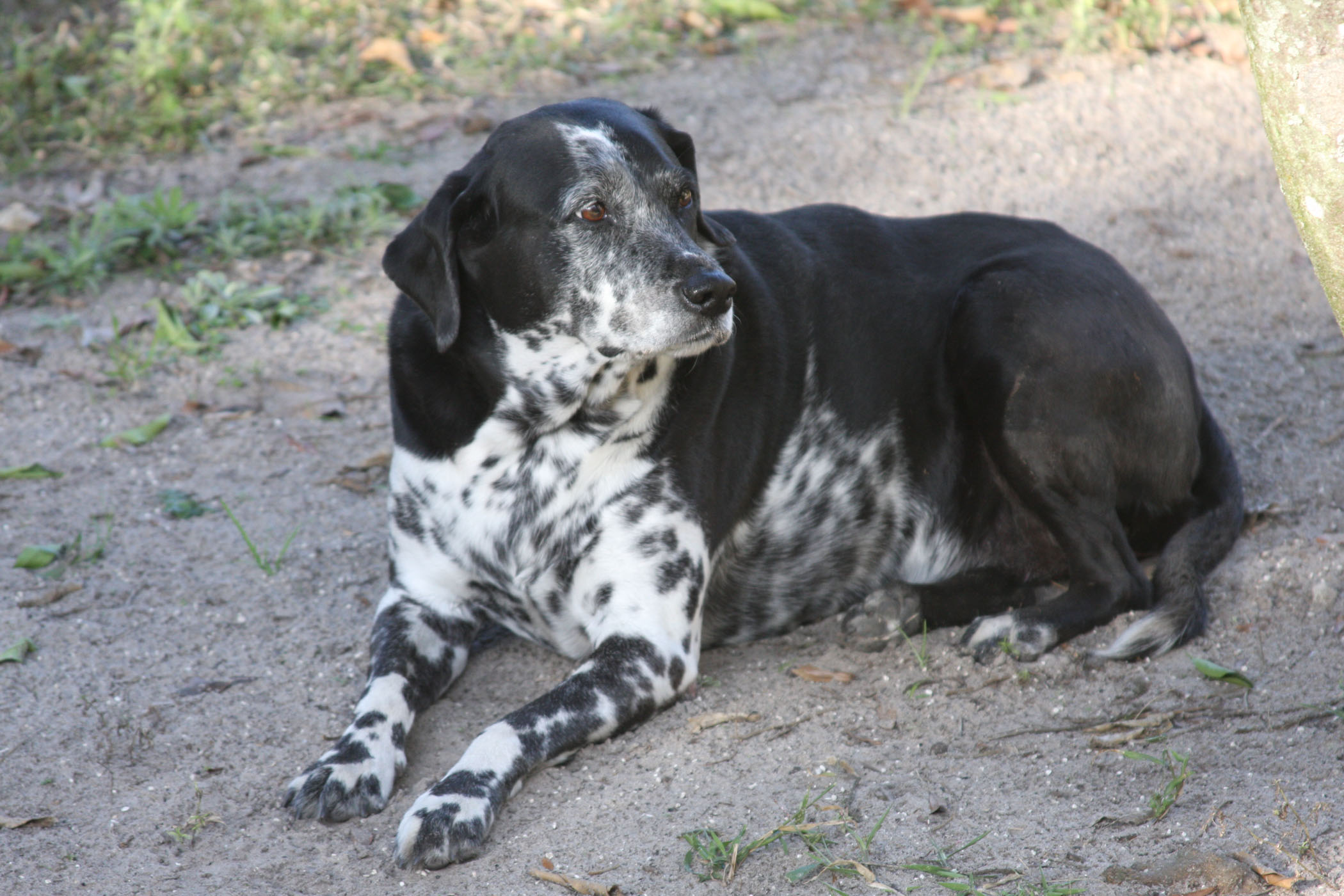
She came to Cross Creek with her husband Charles Rawlings in 1928 hoping to make a home and have a place to write. The dream faded. They divorced in 1933. Charles moved on, leaving behind his hunting dog, a black and white spotted hound named Mo. I picture Mo on the porch with Marjorie, tail thumping the wooden boards when she reached down to scratch him behind the ears.

Marjorie stayed at Cross Creek after the divorce. How could she not? Here is what she said in 1928 when she first arrived:

” When I came to the Creek, I knew the old grove and the farmhouse at once as home.”

Like many women suddenly left to their own devices through divorce or death Marjorie got creative in a hurry. This was not an easy assignment in the Great Depression years. She and her help raised chickens and planted a vegetable garden. There were orange trees on the property. She doubled their number. For a few years oranges provided the main income.

Writing was secondary. One of her early novels was serialized in a magazine – one chapter a month. Pecking away at the typewriter on the porch, she sent chapter by chapter off in the mail then anxiously awaited her checks.

Inside her home, now a National Historic Landmark, one room is set aside to showcase her books. On a top shelf are copies of “The Yearling” translated into different languages. Park Ranger Sheila Barnes tells me Rawlings was fortunate to write at a time when reading ruled. Television and computers didn’t exist. Readers devoured books, especially novels and writers made a living.


For the second edition of “The Yearling” famed illustrator N.C. Wyeth came and stayed three weeks at Cross Creek. It was his first visit to Florida, the first time he ever painted Spanish moss on a tree or captured the quality of late afternoon sunlight on Orange Lake. His illustrations are displayed in a calendar in the reading room.

When I visited recently Barnes came walking towards the gate wearing a period dress from the 1930s. Trotting alongside her was a dog that looked a lot like the old photographs of Mo standing next to Rawlings.

This dog is Sugar, a spotted hound rescued from a shelter. Since park personnel interpret the seasonal life at Cross Creek, it was determined a dog could be added to staff interpretation if it got along well with people and fit the description of dogs owned by Rawlings. Sugar fills the bill beautifully.

Rawlings died in 1953. Her Cross Creek homestead is southwest of Gainesville on County Road 325 and it is a state park.

Marjorie Kinnan Rawlings Historic State Park
is described in its brochure as an “inspirational literary landmark”. A large plaque informs visitors that the house and farmyard were designated a National Historic Landmark in 2006. And in 2008 Marjorie even got her own U.S. Postal Service stamp as part of honoring the literary arts.

When I visit this piece of Old Florida I always feel I’ve stepped onto sacred ground, sacred for a writer anyway, especially the porch. I look at the little typewriter, the vase of fresh flowers nearby, a large glass ashtray next to the typewriter and it seems so immediate. Perhaps Marjorie will be back any minute, sit down at the typewriter and tap away.

The staff clearly loves this place, keeping the kitchen in working order and planting the garden with seasonal vegetables. Both Barnes and Park Manager Valerie Rivers dress in period costume. Staff plus a dedicated group of volunteers contribute to the sense that the past is present.

Visitors can become enchanted easily. You can almost hear Rawlings saying these words:

“I do not understand how any one can live without some small place of enhancement to turn to.”

Enchantment is a marvelous word. Cross Creek was Marjorie’s enchantment.

At the end of the day Rawlings came to understand something quite profound – that we are all caretakers, not owners, of this earth we call home. She closes her book “Cross Creek” with these words:

“It seems to me that the earth may be borrowed but not bought. It may be used but not owned. It gives itself in response to love and tending, offers its seasonal flowering and fruiting. But we are tenants and not possessors, lovers and not masters. Cross Creek belongs to the wind and the rain, to the sun and the seasons, to the secrecy of seed, and beyond all, to time.”

©2008 Lucy Beebe Tobias. All rights reserved. For reprint information, contact Lucy@Lucyworks.com
Lucy Beebe Tobias is the Authentic Florida Expert for VISIT FLORIDA and the author of “50 Great Walks in Florida.”

WHEN YOU GO
What: Marjorie Kinnan Rawlings Historic State Park, 18700 S. County Road 325, Cross Creek, Fl. 32640, phone: (352) 466-3672
Hours: Farmyard and trails open 9-5 every day.
Park Admission Fee: $2 per vehicle
House Tour: A tour inside the house from October through July on Thursday through Sunday at 10 a.m. and 11 a.m. and each hour from 1 p.m. to 4 p.m.
Tour Fee: $3 per adult, $2 children 6-12, under the age of six are free
Next door: M.K Rawlings County Park with boat ramp access to Orange Lake

Raising Eyebrows with Pumpkin Pie from Scratch

We thought it was cool to raise one eyebrow really high and cock your head to one side, like your face was saying “WHAT? YOU EXPECT ME TO BELIEVE THAT?????”

I’d practice in front of a mirror but both eyebrows shot up. Hey, we were teenagers with time on our hands. It was before computers and cell phones.

The other day I told a friend of mine that I was going to make a pumpkin pie from scratch. She raised one eyebrow so high it almost touched her hairline and, in the classic pose, she tipped her head to one side. Then she said “How in the world do you make a pumpkin pie from SCRATCH?” and I knew she was really thinking “YOU EXPECT ME TO BELIEVE THAT?”

It surprised me that even after all these years I could be jealous when someone could raise just one eyebrow. Plus, silly me, I’m surprised about the pie. I thought everyone made pumpkin pie from scratch. It is the best. Beats canned by a country mile. But no, all over America men and women are waiting for the canned pumpkin to go on sale so they can stock up to make a bland uninteresting pie.

Well, why wait? You can do pumpkin pie from scratch. Let’s be authentic. Take my hand. Together we’ll make the real deal step by step:
1. First, buy a small pumpkin. These have the best taste. The big ones are good for Halloween, that’s about it.

2. Cut it in half. Use a big, sharp knife. Do this carefully.

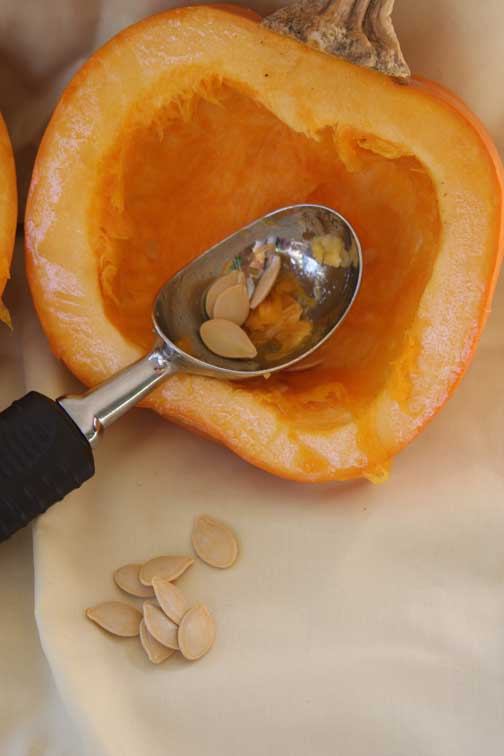
3. Scoop out the seeds with an ice cream scoop. Some folks like to roast the seeds. Roasting and eating them is too much trouble so I don’t do this part. But I am going to plant some in the garden and see what develops.

4. Place the two halves in a baking pan. Put in about one inch of water. Bake about 45 minutes at 325 degrees or until done (a knife goes in easily)

5. Turn cut halves up. Put aside to cool. When cool scoop out the pumpkin meat with the ice cream scoop. From a small pumpkin you will get about one cup of delicious, cooked, fresh pumpkin. Recycle the pumpkin skin into your compost bin (don’t have a compost bin? Now is a good time to start).

6. Use in the pumpkin pie recipe of your choice. This time I used one from Epicurious, a pecan pumpkin pie recipe first published in Gourmet in 1983 then again in 2003. I had never put pecans on top before but they are delicious.

Yum and double yum. You will be the talk of the neighborhood and some of your friends may even raise one eyebrow. I’m still working on that part.

©2008 Lucy Beebe Tobias. all rights reserved

Milkweed Crisis in the Backyard

Holy cow! I’ve got a crisis! In my backyard the monarch caterpillars have chomped through all the leaves on the milkweed plants and they are still hungry. The very last milkweed has five, count them FIVE caterpillars and only TWO leaves left. That isn’t going to cut it. Will they die as caterpillars and never turn into butterflies if they don’t get more milkweed leaves?

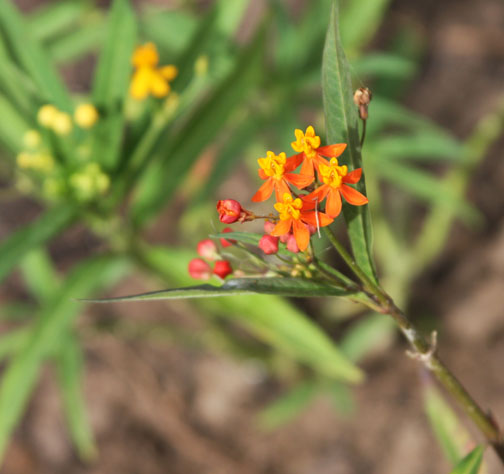
milkweed

milkweed stripped of leaves

Aggggggh! I don’t know the answer but I don’t like the numbers. Rushing to Lowe’s I search in vain for milkweed. “Nope, we don’t have any,” says a bored clerk. I’m sure my crisis would seem like comedy to her. I don’t bother to explain. Rushing back home I phone Taylor Gardens Nursery in Citra.

Guda tells me to come on out, she has a few pots of milkweed left. I drive almost a half hour and ask for five pots, figuring a feast for each caterpillar.

“You know it is late for monarchs to be doing caterpillars,” Guda comments as she picks up pots and pulls out a few weeds. Even as she speaks several female monarchs are flying nearby, looking to lay eggs on the milkweeds.

Monarchs and milkweeds go together like bacon and eggs. They need each other. While some flowers supply nectar for butterflies, each species has its own host plant that it must find to lay its eggs.

That’s why butterfly gardeners will plant say, a red penta, to attract butterflies, and nearby are plants like milkweed and fennel and passion vine for different kinds of butterflies to lay their eggs.

Eggs hatch, caterpillars eat and eat, then metamorphosis happens, they change form completely and emerge as beautiful flying canvases of color.

I hurried home, grabbed a shovel and planted milkweed along the fence line then carefully transferred each caterpillar to its own plant. They began chomping immediately. Crisis solved!

monarch caterpillar

monarch caterpillar eating milkweed leaf

Yes, I know, it isn’t on the same level as solving the economic crisis or bringing our troops home but somehow making a difference in my backyard makes a difference. You have got to start somewhere.

Did you know that monarchs need your help? Killing freezes in Mexico destroyed 75 percent of the wintering population of monarchs from North America. In the spring, summer and fall they need milkweed here to lay their eggs and there is a national shortage of milkweed. It used to grow a lot by the side of the road but spraying and deep cutting has eliminated them.

The Live Monarch foundation seeks to grow milkweed in every back yard! You can get free milkweed seeds by sending a stamped, addressed envelope (with a suggested donation of $2) to: Live Monarch Foundation – Seeds, 3003-C8 Yamato Road #1015, Boca Raton, Florida 33434.

If you don’t want to get down and dirty and dig in the dirt, adopt an online butterfly and watch your monarch go from an egg to an adult butterfly. You get an update every few days with pictures. This is a free educational experience. What are you waiting for? I’m signing up today then going outside to check on the milkweed plants.

New milkweed plants along the fence line

New milkweed plants along the fence line

Lucy Beebe Tobias is the author of “50 Great Walks in Florida”, University Press of Florida, and the Authentic Florida Expert for VISIT FLORIDA

Lessons Learned from Stranded Starfish

Note: This is a true story

My footsteps made no sound on the fog-shrouded beach. I searched the sand for telltale signs of tracks leading out of the water towards the sand dunes. The ones I wanted to see are flat in the middle with indentations on the sides- tracks a female loggerhead turtle makes when she drags herself out the water ever so slowly.

An ancient song heard only by sea turtles makes her leave the buoyant security of water and go ashore to lay eggs. But this morning the beach is bare. I am disappointed. My volunteer job is to walk the beach three times a week, looking for tracks, then call the Turtle Patrol folks if I find them. They will mark the nests and try to ensure the baby turtles make it safely down to the water.

Three times a week I walk a mile, turn around, go back one mile to my car, head home, shower, change and go to work as a newspaper reporter. I love walking the beach to start the day, even on a fog-shrouded morning. This morning it feels like I’ve walked a mile but I can’t see my usual landmarks.

Then I look down one last time and there they are. Hundreds of baby starfish, their little arms silently waving in the air, lie stranded above the tide line. It is a shocking surprise for an early morning walker.

I bend over, pick up several small starfish and throw them into the water. This goes on and on until finally my arms give up and refuse to work. I sink down on my knees, crying.

“I can’t save you all,” I sob. Their little arms wave in the air, pleading. To be left stranded on the sand is sure death when the sun rises. But there are hundreds of them and only one of me.

Finally, I stand up, two big indentations in the sand where I knelt. I turn away and begin slowly walking back to my car, my eyes fogged with tears. By the time I reached for the car door handle, I’d learned something about myself and made a decision.

As a new reporter, a career I started in my 40s, I was trying to save them all. All the lost and almost lost causes – the people who had no homes, the children who had no voice, the animals put to death because of irresponsible owners. Oh yes, I wanted to save them all.

But I couldn’t. The fact is each one of us is gifted with a certain amount of energy. We need to make good choices with this gift, learn to say “no” as well as “yes” and use that energy wisely so it is effective. And we need to increase energy by partnering with others.

The decision? I knew I’d be leaving Fernandina Beach, a place I deeply loved, because I needed to focus on being an environmental reporter and this was not a possibility with the general assignment job I currently had.

Three months after the starfish experience I accepted a job at another paper, and within two years did a stint as an environmental reporter. Did I forget the starfish? Never.

About a year later I heard the often-told tale, fable or real story (who knows?), of a man who walks on a beach, sees lots of stranded starfish and a small boy who is throwing one back in the water. The man asks what difference that will make and the boy answers “It makes a difference to the one I threw back.”

Sometimes an everyday experience like walking on a beach can be life changing. This was one of those times. I’m still trying to make good use of the gift of energy. Every day I do know you can’t save them all but you can make a huge difference for a few. Go for it.

©2008 Lucy Beebe Tobias. All rights reserved. Lucy is a Florida environmental writer living in Ocala.

Getting Wet and Wild in Punta Gorda

We’re wet, we’re happy, we’re discovering things. Are we kids on a field trip? Heck no. We are adults at the annual Florida Outdoor Writers Association Conference held last week in Punta Gorda – yes, we are fully-grown, allegedly responsible people who have elected to go on an environmental wading trip.

I kid you not – they gave us plastic buckets. My plastic beach bucket is a swirly pink and white with a shovel attached. It is charming. I feel four-years old again and ready for the beach. Other pails are purple or yellow. We got them as gifts from the Charlotte Harbor Visitor’s Bureau to take with us on a wading trip.

Giggling, we pick up our buckets and head for the water’s edge.

We are at Ponce de Leon Park in Punta Gorda, Florida. The park faces Charlotte Harbor and is somewhat of a miracle. It was slated to be condos. Instead it is saved for the public to appreciate the tidal zones and marshes, a piece of authentic Florida.

Gingerly, we wade into Charlotte Harbor. Most of us are wearing crocs or sneakers because the sandy bottom has oyster shells that can rip open bare feet. The tide is out. Some of us are dragging what looks like a butterfly net on long pole along the bottom, scooping up algae, shrimp, a hermit crab in a periwinkle shell. It is something different with every scoop.

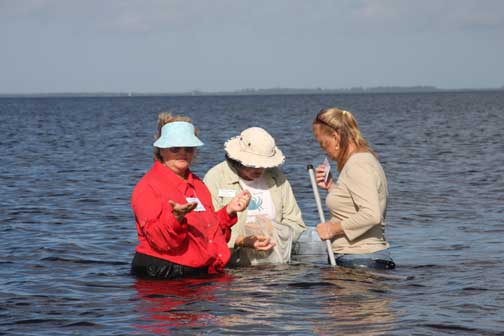
Monica Dorken (center) explains finds from the bottom of Charlotte Harbor to FOWA members. Photo by Lucy Beebe Tobias

Monica Dorken (center) explains finds from the bottom of Charlotte Harbor to FOWA members Sandy Huff (left) and Karen Smith (right). Photo by Lucy Beebe Tobias

Monica Dorken, our guide from the Charlotte Harbor Environmental Center, wears a weather-beaten hat. We knew immediately she had to be our guide even before seeing her nametag. An old hat is required guide attire.

The brave ones in the group wade out deeper. Water is up to their waists, then practically to their shoulder! Those of us with cameras hang back; reluctant to get inn over our knees, worried about dropping the camera.

Monica tells us about all the fourth graders she’s taken on these field trips, and I’m thinking, why should kids have all the fun? Why indeed. Let’s get wet and wild.
She brings out a cool viewer – put in some salt water and anything you’ve found, look through the viewer and a shrimp becomes gigantic.

Monica Dorken shows a cool viewer for seeing things up close.

Monica Dorken shows a cool viewer for seeing things up close.

The Center does these trips for free and sometimes schedules them for adults. Check their calendar.

In another lifetime I wanted to be a marine biologist and study the inter tidal zone. But life has a way of happening when you are making other plans. It feels great to be back in the intertidal zone. So much action here – the food web at work, with meals changing with the tides.

On this day, I’m amazed, once again, at how everything is connected. What runs off our lawns into the bays and oceans affects life there. Monica brings some really cool magnifying viewers. Put in some seawater and look inside. A small shrimp become gigantic.

Even trash has an effect on the environment. FOWA member Rodney Smith finds a green glass bottle in the water and shakes it to see if any small crabs are living inside.

FOWA member Rodney Smith checks to see if any sealife lives inside this discarded bottle

FOWA member Rodney Smith checks to see if any sealife lives inside this discarded bottle

A yellow-crowned night heron lands on a mangrove limb. Writer/author Sandra Friend captures the moment on camera. Her husband, cartoonist Rob Smith, sits on a tree limb, sketching nearby mangroves.

Before we got wet, Margo gave a talk on all the things we might see before we got wet. We handle a whelk egg case and starfish. It is not our day to find these things in the water. But no matter. We leave soaked and satisfied. When is the next field trip? I’m ready. I’ve got my plastic bucket.

Lucy Beebe Tobias is a member of FOWA and the author of 50 Great Walks in Florida, February, 2008, University Press of Florida. ©2008 Lucy Beebe Tobias. All rights reserved.

Page 1 of 212»