Take a Boat Ride in History’s Wake

Breakfast at the Old Spanish Sugar Mill Restaurant inside DeLeon Springs State Park is an event. The tables have built in griddles. Our waitress showed us the button to turn on the griddle (gee, that was the hard part, it was on a table leg, we never would have found it).

As the griddle warmed, she brought coffee, big pitchers of home-milled pancake batters and the sides we’d chosen – blueberries and eggs. We began pouring batter, laughing, enjoying the moment, watching for the telltale bubbles that mean it is time to flip those pancakes.

flipping pancakes

Barbara Fitos flipping pancakes

Our table faced the windows. We looked out at DeLeon Springs headspring with its walled off swimming area and a waterfall spilling over boulders into Spring Garden Lake. This tranquil scene, with 19 million gallons of water a day coming from an underground cavern, empties its crystal clear water into Spring Garden Creek, then onto Lake Woodruff National Wildlife Refuge, the St. Johns River and eventually this water flows into the Atlantic Ocean. What a journey! And it begins here.

sugar mill and waterfall

sugar mill and waterfall


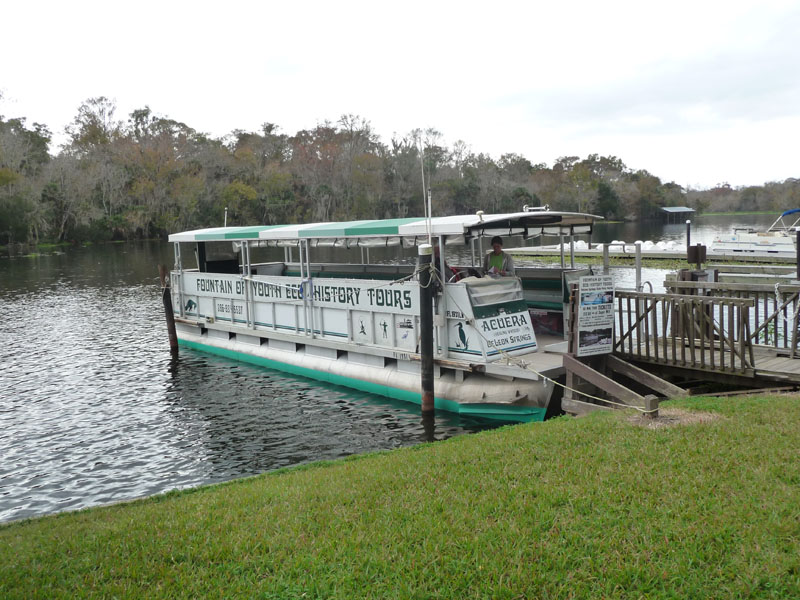
Across the way sat M.V Acuera, a 28-seat pontoon boat with a canvas roof cover. On the sides it says Fountain of Youth ECO/History Tours. Our plan: first, enjoy breakfast, and then take a boat trip. It worked but not quite the way we’d envisioned.

P1010296

Tours leave at 10 a.m., 11 a.m., noon and 1 p.m. Tickets are $12. The narrated boat ride lasts 50 minutes, going down Spring Garden Creek and into Lake Woodruff National Wildlife Refuge. Reservations can be made at Sugar Mill or call the boat tour (386)-837-5537. To know more, visit the eco-tour’s Website.

BUT, and it is a big “but”, there must be a minimum of eight passengers for a tour to leave the dock. We were just two people ready for the 11 a.m. Apparently no one else wanted to leave the griddles.

So off we went to nearby DeLand, walking around downtown, visiting galleries, shops and museums. Captain Frank assured us he had 12 signed up for the 1 p.m. We returned (your park entrance receipt gets you back in all day) and boarded the M/V Acuera.

Captain Frank tells us Native Americans used to visit the springs 6,000 years ago. That was long before pancakes. In the early 1800′s Major Joseph Woodruff and his wife Jan bought 2,000 acres, grew sugar cane and indigo.

“He was the first to bring slaves to Florida,” Frank says.

There on the right – an anhinga and a great blue heron. On the left, snowy egrets and moor hens. An osprey sits high in a tree.

osprey in a tree

osprey in a tree

It is late fall, some color on the trees, most are bare.
“Come earlier in the fall for a brilliant change of color in the fall bright sunshine,” says Frank.

We see white ibis, lots of them, they were the sacred bird of Egypt.

Colonel Orlando Rees bought it in 1831 and made the earthen dam to power a sugar mill. Naturalist John James Audubon visited Rees in 1832 and Rees took him on a boat trip along the waterways, just like we are doing now. This is a great way to see birds. As we smoothly glide along, bird sighting are frequent. We also ask about plants.

Captain Frank points out smooth beggar tick – an unusual name – for yellow flowers blossoming by the water’s edge.

“This is old Florida, the way it looked for centuries, this is what the Spanish saw, what the Indians saw,” Frank says.

P1010288

River views

River views

In the reeds an immature lack-crowned night heron and a female cormorant. We see an immature little blue heron – they are born white then turn blue in one to two years.

Alligators, big ones, sun themselves on the banks. Capt. Frank says they have 3,000 pounds of pressure in their jaws. We take his word for it.

A tri-colored heron is spotted in the shallows. Overhead a red-shouldered hawk flies by. A cooter turtle suns itself on a log.

We are floating in the Refuge now, some 20,000 acres of preserved land and water.

In the 1800s no highways existed. “The only roads were waterways, product was shipped by water, the only way to get to market,” says Captain Frank. He waves his hand outward. “It is 126 miles by water to Jacksonville. Steamboats came in the late 1820s, that is what really settled Florida from the center out, steam boat traffic, towns developed along the rivers and people came.”

And we come today to float in history’s wake, catch a glimpse of immature yellow crowned night herons and watch a kingfisher fly by. There are moments when you just have to say: “it doesn’t get any better than this.”

Short, narrated boat trips are a great way to see authentic Florida. We loved doing breakfast and a boat trip at DeLeon Springs and we’ll be back with family and friends.

Here are more possibilities:

A boat tour on the Wakulla River at Edward Ball Wakulla Springs State Park located southwest of Tallahassee. Upcoming tours include a photo tour on the Wakulla River on Saturday, Feb. 6 and a Valentine’s Cruise & Dinner on Saturday, Feb. 13.

A tour boat at Jonathan Dickinson State Park in Hobe Sound goes up the Loxahatchee River to Trapper Nelson’s homestead and a ranger-guided tour of the homestead.

A little more adventuresome – From Fort Myers, it is a three-hour (or more) catamaran ride to Key West on the Key West Boat Shuttle. Spend the day or two, return by boat.

Since seeing birds is such a big part of a river boat trip, I recommend a good field guide, particularly the Sibley Guide to Birds.
P1010311

Pretty amazing that he illustrated every bird. I like the different views. A bird will fly overhead and all you see is the underside. Well, Sibley have those undersides.

©2009 Lucy Beebe Tobias, author of “50 Great Walks in Florida”.. All rights reserved.

Go Native One Plant at a Time

Jeff Nurge went native eight years ago. He planted native flowers, bushes and trees in an effort to attract wildlife. You can’t really tell from the front – native trees and bushes are spaced apart. It is the sides and back of the house that get your attention.
P1010188

These areas pulse with dense green foliage not unlike well, wild Florida.

Narrow paths make passing through possible. Seemingly random growth turns out to have specific lures for wildlife – a red bay, for example, has tiny flowers that bees love and the tree is a good shelter for birds.

P1010194

“I wanted to see birds, snakes, owls, butterflies,” says the Delray Beach resident. And he does. In addition he wanted to conserve water. That too is happening.

A back fence has completely disappeared, hidden under flourishing firebush.

“This is a huge butterfly attractor,” Jeff comments. “Firebush is the number one native plant. This is the first plant to start with.”

I’m startled and surprised by what it means to go native. It means forget neat and manicured. This was once a conventional yard with grass underfoot and fence to mark the property line. Now it vibrates with exuberance and yes, a touch of chaos, all for a good cause – there is only so much space and so many natives to plant and so little time.

You see our wildlife is in trouble.

“So many landscapes are loaded with exotics,” notes Jeff. “They are beautiful but they are dead zones for wildlife. They have color and texture but where are the bees, the birds, the lizards?”

Dead zones? Beauty that kills here in Florida? Sounds like a science fiction novel but no, this is the real deal.

“The bird population and butterflies are not finding the food they need – the migrating birds need to feed in Florida to migrate to South America. If they can’t find the right food, they don’t make it.”

In my back yard, a haven with water fountains and bird feeders, or so I thought, the bird numbers have been dwindling in recent years. I was hoping they got a better offer and are happy somewhere else. Now I wonder if they made it from one year to the next.

Going native turns out to be a call to action – do you want to save native wildlife? Then turn your dead zone into a native buffet and you can do it one plant at a time. Before visiting Jeff I thought my side yard would become a fruit orchard. Now it is going native.

I planted firebush along the fence line. You go, you native you. Do your thing. The butterflies will love you.

RESOURCES

• Jeff recommends several native plant nurseries in his area including Pan’s Garden in Palm Beach, Meadow Beauty Nursery and Indian Trails Native Nursery, both in Lake Worth.

• “A Gardener’s Guide to Florida’s Native Plants” (paperback) by Rufino Osorio, here is the Amazon link and it is in our bookstore on my Website.

• Jeff, who is also a Master Gardener, has turned his native passion into a consulting business. Visit his Website to know more.

Master Gardeners, an outreach program by IFAS University of Florida, may have an office near you. They can be immensely helpful, especially with micro irrigation and drought resistant plant suggestions.

Florida Native Plant Society has chapters throughout the state.

• Here is the link for University of Florida IFAS Extension section on native plants. IFAS means the Institute of Food and Agricultural Sciences.

• Native plant nurseries will only flourish if people vote with their wallets and buy native. Here is a listing of native plant sources from Florida Gardener.

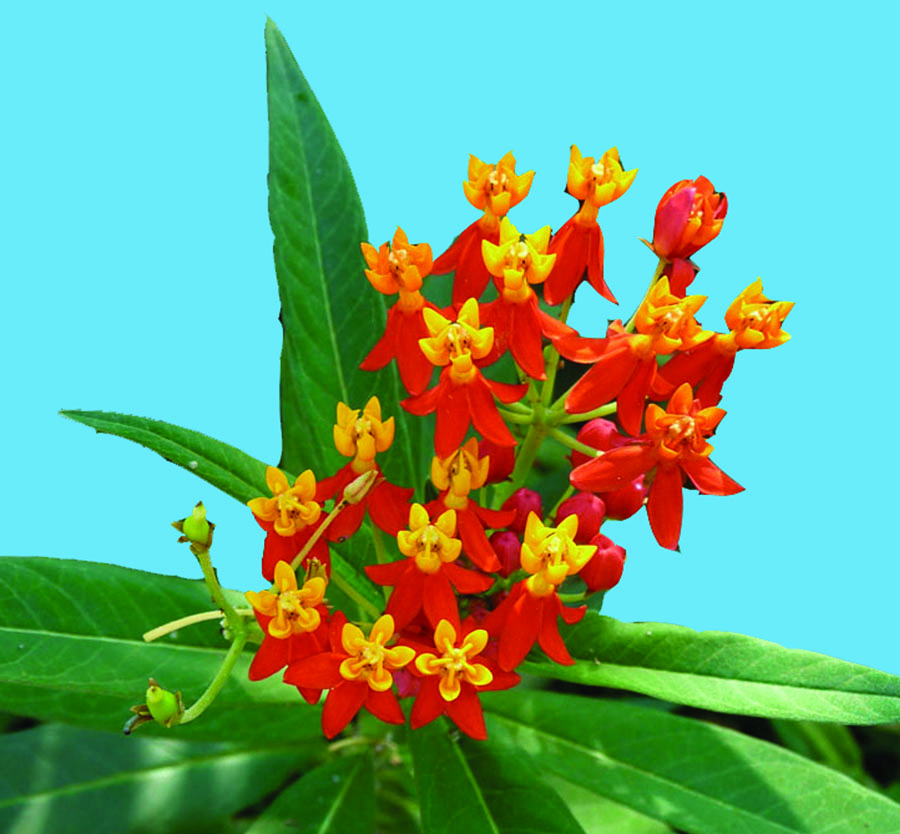
While milkweed is not a native it is the necessary larval plant for monarch butterflies. Learn more at the Live Monarch Foundation.

©2009 Lucy Beebe Tobias, all rights reserved.