Lessons Learned from Stranded Starfish

Note: This is a true story

My footsteps made no sound on the fog-shrouded beach. I searched the sand for telltale signs of tracks leading out of the water towards the sand dunes. The ones I wanted to see are flat in the middle with indentations on the sides- tracks a female loggerhead turtle makes when she drags herself out the water ever so slowly.

An ancient song heard only by sea turtles makes her leave the buoyant security of water and go ashore to lay eggs. But this morning the beach is bare. I am disappointed. My volunteer job is to walk the beach three times a week, looking for tracks, then call the Turtle Patrol folks if I find them. They will mark the nests and try to ensure the baby turtles make it safely down to the water.

Three times a week I walk a mile, turn around, go back one mile to my car, head home, shower, change and go to work as a newspaper reporter. I love walking the beach to start the day, even on a fog-shrouded morning. This morning it feels like I’ve walked a mile but I can’t see my usual landmarks.

Then I look down one last time and there they are. Hundreds of baby starfish, their little arms silently waving in the air, lie stranded above the tide line. It is a shocking surprise for an early morning walker.

I bend over, pick up several small starfish and throw them into the water. This goes on and on until finally my arms give up and refuse to work. I sink down on my knees, crying.

“I can’t save you all,” I sob. Their little arms wave in the air, pleading. To be left stranded on the sand is sure death when the sun rises. But there are hundreds of them and only one of me.

Finally, I stand up, two big indentations in the sand where I knelt. I turn away and begin slowly walking back to my car, my eyes fogged with tears. By the time I reached for the car door handle, I’d learned something about myself and made a decision.

As a new reporter, a career I started in my 40s, I was trying to save them all. All the lost and almost lost causes – the people who had no homes, the children who had no voice, the animals put to death because of irresponsible owners. Oh yes, I wanted to save them all.

But I couldn’t. The fact is each one of us is gifted with a certain amount of energy. We need to make good choices with this gift, learn to say “no” as well as “yes” and use that energy wisely so it is effective. And we need to increase energy by partnering with others.

The decision? I knew I’d be leaving Fernandina Beach, a place I deeply loved, because I needed to focus on being an environmental reporter and this was not a possibility with the general assignment job I currently had.

Three months after the starfish experience I accepted a job at another paper, and within two years did a stint as an environmental reporter. Did I forget the starfish? Never.

About a year later I heard the often-told tale, fable or real story (who knows?), of a man who walks on a beach, sees lots of stranded starfish and a small boy who is throwing one back in the water. The man asks what difference that will make and the boy answers “It makes a difference to the one I threw back.”

Sometimes an everyday experience like walking on a beach can be life changing. This was one of those times. I’m still trying to make good use of the gift of energy. Every day I do know you can’t save them all but you can make a huge difference for a few. Go for it.

©2008 Lucy Beebe Tobias. All rights reserved. Lucy is a Florida environmental writer living in Ocala.

Getting Wet and Wild in Punta Gorda

We’re wet, we’re happy, we’re discovering things. Are we kids on a field trip? Heck no. We are adults at the annual Florida Outdoor Writers Association Conference held last week in Punta Gorda – yes, we are fully-grown, allegedly responsible people who have elected to go on an environmental wading trip.

I kid you not – they gave us plastic buckets. My plastic beach bucket is a swirly pink and white with a shovel attached. It is charming. I feel four-years old again and ready for the beach. Other pails are purple or yellow. We got them as gifts from the Charlotte Harbor Visitor’s Bureau to take with us on a wading trip.

Giggling, we pick up our buckets and head for the water’s edge.

We are at Ponce de Leon Park in Punta Gorda, Florida. The park faces Charlotte Harbor and is somewhat of a miracle. It was slated to be condos. Instead it is saved for the public to appreciate the tidal zones and marshes, a piece of authentic Florida.

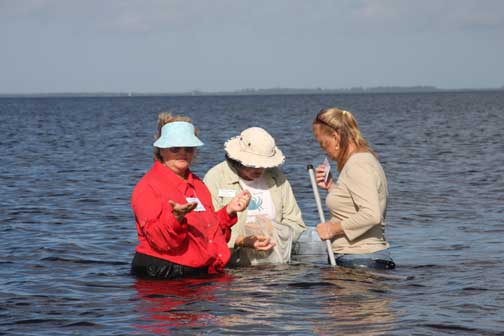
Gingerly, we wade into Charlotte Harbor. Most of us are wearing crocs or sneakers because the sandy bottom has oyster shells that can rip open bare feet. The tide is out. Some of us are dragging what looks like a butterfly net on long pole along the bottom, scooping up algae, shrimp, a hermit crab in a periwinkle shell. It is something different with every scoop.

Monica Dorken (center) explains finds from the bottom of Charlotte Harbor to FOWA members. Photo by Lucy Beebe Tobias

Monica Dorken (center) explains finds from the bottom of Charlotte Harbor to FOWA members Sandy Huff (left) and Karen Smith (right). Photo by Lucy Beebe Tobias

Monica Dorken, our guide from the Charlotte Harbor Environmental Center, wears a weather-beaten hat. We knew immediately she had to be our guide even before seeing her nametag. An old hat is required guide attire.

The brave ones in the group wade out deeper. Water is up to their waists, then practically to their shoulder! Those of us with cameras hang back; reluctant to get inn over our knees, worried about dropping the camera.

Monica tells us about all the fourth graders she’s taken on these field trips, and I’m thinking, why should kids have all the fun? Why indeed. Let’s get wet and wild.
She brings out a cool viewer – put in some salt water and anything you’ve found, look through the viewer and a shrimp becomes gigantic.

Monica Dorken shows a cool viewer for seeing things up close.

Monica Dorken shows a cool viewer for seeing things up close.

The Center does these trips for free and sometimes schedules them for adults. Check their calendar.

In another lifetime I wanted to be a marine biologist and study the inter tidal zone. But life has a way of happening when you are making other plans. It feels great to be back in the intertidal zone. So much action here – the food web at work, with meals changing with the tides.

On this day, I’m amazed, once again, at how everything is connected. What runs off our lawns into the bays and oceans affects life there. Monica brings some really cool magnifying viewers. Put in some seawater and look inside. A small shrimp become gigantic.

Even trash has an effect on the environment. FOWA member Rodney Smith finds a green glass bottle in the water and shakes it to see if any small crabs are living inside.

FOWA member Rodney Smith checks to see if any sealife lives inside this discarded bottle

FOWA member Rodney Smith checks to see if any sealife lives inside this discarded bottle

A yellow-crowned night heron lands on a mangrove limb. Writer/author Sandra Friend captures the moment on camera. Her husband, cartoonist Rob Smith, sits on a tree limb, sketching nearby mangroves.

Before we got wet, Margo gave a talk on all the things we might see before we got wet. We handle a whelk egg case and starfish. It is not our day to find these things in the water. But no matter. We leave soaked and satisfied. When is the next field trip? I’m ready. I’ve got my plastic bucket.

Lucy Beebe Tobias is a member of FOWA and the author of 50 Great Walks in Florida, February, 2008, University Press of Florida. ©2008 Lucy Beebe Tobias. All rights reserved.