Ring the Bell at Liberty Bell Museum in Melbourne

A small arrow on a city map points to a building labeled “Liberty Bell Museum”. Funny, I thought the Liberty Bell was in Philadelphia. Here I am cruising around Melbourne, Florida. What’s up?

Curiosity got the better of me. I’m glad it did. Got turned around and lost getting there but hey, you are not really lost if you find what you were looking for, right?

A sign says the museum opens at 10 a.m. I have the pick of the parking lot. It is empty except for me. The museum building looks odd – a round shape with a curved top. Windows are painted on the side. Why no real ones?

Promptly at 10 a.m. a white-haired woman comes out the museum front door carrying a banner with a flag hanging down that says, “Open”. She looks determined. Maybe because she faces a long walk down a long boulevard, a good city block in length, then onto a lawn bordering a street where she puts the sign into a holder.

The Liberty Bell Memorial Museum and Melbourne Military Memorial Park sit together. The grand boulevard reflects that bigger design.

I take it as a good sign someone came out the door and head for the museum entrance. The door opens just as I reach for the handle. A woman holds an American flag. She looks surprised to see me.

“Come in,” she invites. “I’ll be right back to give you a tour.” She too is on a flag mission and puts up the American flag on a pole near the bottom of the museum steps. I wonder do museum volunteers flip a coin to see who gets the long walk flag duty and who gets the short walk?

Inside the main round room, sure enough, there is a liberty bell right in the center. This one doesn’t have a crack.

For our nation’s 1976 Bicentennial Celebration the Whitechapel Bell Foundry in London, England, the same one that cast the original bell made in 1751, sent a letter to all 50 states asking if they’d like to buy a bell replica.

Melbourne school children raised $13,000 and a bell was purchased. Florida’s replica resides inside a water tower, recycled to be a museum (hence the round shape and no windows).

You can ring the bell using a rubber mallet. The harder you hit, the deeper the sound. It has a lovely reverb that goes on and on, mellow and mysterious.

I felt it was an honor to ring the bell. With tongue firmly in cheek the docents give me a business card announcing I was now a member of the Ding Dong Society.

Docents, all volunteers, are gracious and knowing. We walked around looking at glass cases and exhibits on the walls. Lots of memorabilia packed in a small space. Melbourne had a Naval Air Station that was one of seven U.S. Navy operational training bases during World War II. They also had a German POW camp.

A hole was cut in the water tower wall and a long rectangular room added for more museum space. In here are many military uniforms, which brought back memories of my dad dressed in his Navy blues.

My docent points out a case full of binoculars. On the wall a small WWII poster says “Will You Supply Eyes for the Navy?” She tells me FDR himself asked the American people to donate their binoculars and include their name and address so the glasses could be returned after the war. The case if full of binoculars never returned because the owners are unknown.

Museum hours are 10 a.m. to 4 p.m. Tuesday through Friday and Saturday from 10 a.m. to 2 p.m. No admission charge. Donations welcomed. The museum sits right next to the Melbourne water tower. Both the museum and the memorial park are part of Wells Park.

The park continues across the street with a huge pond and a walking path all the way around. Nearby are picnic tables and playground equipment.

I loved learning bits and pieces of history here in Florida. Did you know we had a liberty bell replica? Me neither. I’d go back and ring the bell again in a heartbeat.

©2008 Lucy Beebe Tobias. All rights reserved. Lucy is an author, artist, and authentic Florida expert living in Ocala, Florida

Ten Things You can do Right Now to Reduce Global Warming

Here are 10 things you can do right now to reduce global warming and oh yes, save money on gas and food. This list was first developed for Vacation Bible School this summer at Fort King Presbyterian Church in Ocala. It works!

1. Buy produce grown locally. Get to know your local farmers. Support organic growers. Suggestions: Find the closest Farmer’s Market in Florida and mark the day on your calendar. Nothing near you? Talk it up at meetings, at church, at the next gathering of friends and start the ball rolling.

2. Pick one day a week to be car free. Park it. Walk, ride a bike, or, gasp!, stay home and get to know your back yard, front yard, even talk to the neighbors. PS you release nearly a pound of CO2 for every mile driven. Bummer.

3. Plant a vegetable garden. Start with a container or two now in the hot summer (tomatoes, peppers), work the ground for a fall planting. Remember everything you buy grown far away costs energy to deliver it to your door. Break that cycle. Don’t have room? Share a plot with a neighbor who does.

A good book to read: “Food Not Lawns: How to Turn Your Yard into a Garden and Your Neighborhood into a Community”, H.C. Flores, Chelsea Green Publishing Company, 2006. Amazon has it.

4. Shop with a neighbor. Trade off driving to the grocery store once a week.

5. Consider a carpool to church or school or work. Look around the church pews on Sunday. Look around the office or the classroom. See anyone who lives near you?

6. Start a compost pile. Make your own compost. It is richer than dirt. Those bags of topsoil you are buying at Lowes and Home Depot were produced somewhere else and lugged here. That is global warming in action. Break the cycle.

7. Take a rain barrel workshop. Save rainwater. Every drop counts. Just FYI, in Kentucky, they are making rain barrels from oak whiskey barrels. Plants watered with this rainwater are said to be smiling. (just kidding). Water use and global warming go together. The hotter it gets the more water we use. A good book to read: “Mirage: Florida and the Vanishing Water of the Eastern U.S.”, Cynthia Barnett, University of Michigan Press, 2007. Amazon has this book.

In Florida, the Institute of Food and Agricultural Services at University of Florida in Gainesville, is big into rain barrels. Check out your local Agricultural Extension Service office to see if they offer rain barrel workshops and inexpensive rain barrels. In Marion County, we can get them at the Ag office for $50 and that includes all the hardware you need. See my blog on rain barrels. Have fun!

8. Get a dog. Okay, this is a little radical but think of the consequences. Dogs need to be walked. You will be walking the dog. Less time spend running around in the car doing “errands”. Plus, when you are walking the dog, you slow down enough to appreciate natural beauty. Pretty soon you’ll want to spend more time outdoors and less time at the mall. A win win situation for you and the planet, not to mention the dog.

9. Drive the speed limit. Set your cruise control. It is a concept, driving the speed limit. More people are actually doing it with gas prices going up. You will save gas driving slower. Trust me.

10. Turn off your sprinklers. Don’t water your lawn. Let God do it. Plant native plants that are drought tolerant.

To get in the mood, take this test to see the size of your ecological footprint. Ah! Revealing isn’t it, how many planets it takes to support your lifestyle. Now read the list of 10 things you can do again and get started. Good luck!

©2008 Lucy Beebe Tobias, author, artist, authentic Florida expert

Bodacious Biscotti Comes From the Heart

Back in the dinosaur days before computer games and cell phones, most kids played outside, riding bikes, playing baseball, doing anything to stay out of the house until dinnertime.

But not Maria Muscalo. She was in the kitchen at the family’s Tampa home, soaking up the vibes and loving it. Maria said she’d sit in a kitchen chair and ask lots of questions.

“I hung out in the kitchen with the old folks,” Maria says, her face glowing with good memories. Her grandfather and grandmother came over from Naples, Italy in 1890. There were eight boys and two girls. Aunt Phil (short for Philomena) taught her younger sister, who became Maria’s mom, the family recipe for biscotti.

I’m hearing the family history as we sit at a table under an umbrella at the Thursday Farmer’s Market at Circle Square Commons in Ocala. Two women approach the nearby kiosk loaded with packaged biscotti of different kinds and sample pieces. Their eyes cut to the free samples.

“Excuse me,” Maria says, gets up and heads for the potential customers. She’s wearing a white shirt with the name “Grandma Rie” in red on one side (the name her grandchildren call her) and the words “Bodacious Biscotti” on the other.

“Hello, would you like to try some bodacious biscotti?”
The two women stand rooted, interested but not moving forward.
“Our biscotti is famous for what is NOT in it,” Grandma Rie says, giving them her 100-watt smile that comes straight from the heart.

The two women look at each other. This is certainly different! They step up, get some free coffee and try the samples. One bite and they’re hooked. Biscotti means twice baked, that’s why it is dry and crunchy, just right for dipping in coffee.

“When I was 10 years old, I learned how to make biscotti,” Maria says. “I often made it with my Aunt Phil but my mom stopped making it after my brother was born when I was 11.”

Maria never stopped. She picked up the family recipe and ran with it.
“Over the years I’ve given at least 10,000 biscotti away to family and friends.”
Her full name is Maria Musalo Canerossi Buchman. She made biscotti growing up, during a first marriage, while raising two sons, all through working full time, then while divorced and remarried now for 30 years to Ralph Buchman.

Last year while making biscotti in her son’s kitchen in North Carolina, her daughter in law said, “Why don’t you stop giving away your bodacious biscotti?”

She came home, pitched the idea to Ralph, a retired CPA, and he said, “Let’s go for it.” And so the business was born. He took care of all the legal stuff.
Did I mention Grandma Rie is 73 years old? What a wonderful role model. Go Grandma!

She holds up a package of her biscotti and says to the two women: “You go to a grocery story and you need a magnifying glass to read the ingredients in biscotti. Not mine, it is very simple. There are no artificial flavors, no preservatives, no added fats.”

Here’s the ingredient list for her Classic Almond: Unbleached wheat flour, white sugar, whole almonds, whole eggs, baking power, salt vanilla extract, almond extract.

Underneath the ingredient list it says, “We only add Love!” I believe it.

The two women buy several packages and walk away smiling.

“I’m having a blast,” says Grandma Rie. “It is my turn.” Here is what she means by that: “I helped my first husband get an education. I helped my second husband with his practice. Now it is my turn. I never had anything I did on my own.”

As we’re sitting at the table, Ralph is helping more customers. He’s smiling. Looks like being at the Farmer’s Market beats being a CPA. Right now they are putting out 200 dozen biscotti a week, baking them under contract with a bakery. You can find Grandma Rie at Circle Square Farmers Market on Thursdays and Union Street Farmers Market in Gainesville on Wednesdays. They hope to expand to local coffee houses and later to national markets.

And now you can order Bodacious Biscotti on line. Her sons worked on a web site and it just went live.

“I love my sons, they are so smart,” Marie says, eyes sparkling. Marie herself had straight As and her dad wanted to send her to college. Instead she opted to stay home and went to work.

Here is this Italian grandmother, starting a new business at 73. She is vivacious and outgoing. I realize when I buy her biscotti (I’m VERY partial to Classic Almond) that I’m also getting a bite of Grandma Rie’s beautiful take on life.

We hug and I’m about to leave. Grandma Rie draws herself up straight, looks me right in the eye and says “You are never too old to start something new.”

Now that is truly bodacious.

©2008 Lucy Beebe Tobias. Her book “50 Great Walks in Florida” , University Press of Florida, February, 2008, is available here.

A Few Moments of life at Villa Lucia

As a reporter it used to get to me when people said “a picture is worth a 1000 words”, hey, I was the one writing those words! Why should the photographers have all the fun? But photos tell the story ever so well. Here are four photos capturing current moments from Villa Lucia – they are worth 4000 words! Enjoy

An iris in bloom next to the pond. There are four in bloom right now, on tall spikes about four feet high. Very showy.

Finally! A swallowtail butterfly caterpillar on the fennel in the back yard. I’d been hoping the swallowtails would lay their eggs on the fennel, conveniently located right next to a bright red penta. They got the message!

Mexican pentas in bloom. The pond area is full of them, all volunteers.

And last, but certainly not least, please join me in welcoming Obi, a two-year old Corgi from Sunshine Corgi Rescue and the newest family member. He is the missing piece of the puzzle for us!

Lucy Beebe Tobias is the Authentic Florida Expert for VISIT FLORIDA and the author of “50 Great Walks in Florida”, University of Florida Press, February, 2008. ©2008 Lucy Beebe Tobias. All rights reserved.

Sweetwater Preserve Opens in Gainesville

Instead of a ribbon cutting, Sweetwater Preserve had a vine cutting for its opening on July 18,2008

Two reasons to cheer – new trails to walk plus another piece of natural Florida saved from concrete and condos.

Alachua County Forever opened its fifth property to the public on July 19, 2008, with a vine cutting at Sweetwater Preserve.

Bob Simons
, a member of the Alachua County Land Conservation Board, along with Sandra Vardaman, county land conservation biologist, Alachua County Commission Chair Rodney Long and Robert Hutchinson, executive director of the Alachua Conservation Trust, used branch cutters to snip away at the vines. It took a few snips and some laughter but they got the job done.

Onlookers divided into two groups for guided walks around the property. There are two trails. A West Trail for 1.75 miles and an East Trail, a 1.2-mile walk. The 1.2 nature walk starts out as a sand trail with cut logs on the sides and takes visitors through eight different natural communities, as elevations change from high and sandy to low and swampy. The natural community names sound exotic, like way stations in a science fiction novel – upland mixed forest, seepage slope forest, sinkhole lake, xeric hammock and floodplain forest.

mark stowe shows walking sticks on underside of a palmetto leaf at Sweetwater preserve

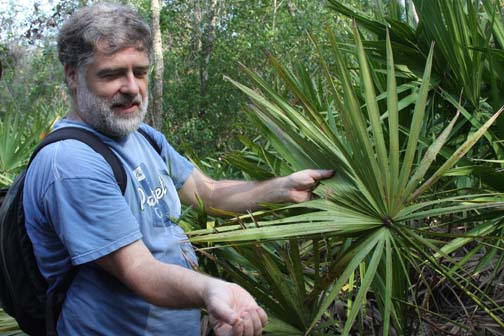
Mark Stowe shows walking sticks on underside of a palmetto leaf at Sweetwater preserve

On the guided opening day walk, a Gainesville spider expert, Mark Stowe, a research assistant in University of Florida’s Department of Zoology, kneels down and uncovers a purse web at the base of a tree. You had to squint and look close to see it – a flexible tube the color of the tree – but once revealed walkers start spotting others along the trail.
Stowe turns over a palmetto leaf to reveal walking sticks on the other side. Perhaps trying to hide but they don’t succeed. Seems bears like to eat them a lot.

Erick Smith shows a pygmy hickory growing in Sweetwater Preserve


Erick Smith,
private consultant, led one walk. He advised staying on the trail as the area is loaded with ticks. If you go walking here, wear long trousers, tuck trouser bottoms inside socks, and check yourself afterwards. This is good advice.

Sweetwater Preserve covers 125 acres and was purchased in 2006 by Alachua County with funding from Alachua County Forever Bond and a Florida Communities Trust grant. The land sits just north of Paynes Prairie Preserve State Park but a fence divides the two and there is no place to cross from one to the other at this time.

A couple walks their dog on the Sweetwater Preserve trail

A couple walks their dog on the Sweetwater Preserve trail

For many years this was pastureland. As the biologists like to say, it is “highly disturbed” but promising. Lots of restoration ideas are going to get a tryout here. Go now and come back in a year and things will be much different. Enjoy the details – a zigzag spider web with a white zig zag in the middle of the web. No one knows why the spider does this. Stowe suggests the spider is making an announcement to birds that “you don’t want to preen your feathers and I don’t want to build a new web so why not stay clear?”

Sweetwater Preserve Trailhead is 1200 feet north of the Boulware Springs Park Gainesville-Hawthorne Trailhead (see map). Park here and walk or bike to Sweetwater. If you are riding a bike, chain up on the cool snake bike rack at the Sweetwater Trailhead. Designed by Kevin Ratkus of Alachua County Forever one end depicts a Scarlet King Snake and the other end has a Coral Snake painted on the bars. An information kiosk has free trail maps of Sweetwater Preserve or you can download them.

location map for Sweetwater Preserve

location map for Sweetwater Preserve

©2008 Lucy Beebe Tobias,all rights reserved.Lucy Beebe Tobias is a Florida Environmental Writer. Her book “50 Great Walks in Florida” is available at www.lucyworks.com